Wednesday, 15 June 2011

Life saving changes.


The black and white photo above is in this years calendar printed for "Scottish Fishermen's Organisation LTD.

It is in for the month of June and I have been looking at it every morning when I come to my computer.
The boy standing aft is me in my teens on the family boat Olive Tree which at the time was a modern fishing vessel, but each morning this month as I look at it I always notice something that has changed drastically, none more so than the life raft.

The oblong box on the galley roof just aft of the wheelhouse is where the life raft was situated at the time, which meant that if the boat was sinking two men would have to clamber up there to release the raft.

Their first task when they reached the wooden box would be to unhook the four hooks at each corner that held the lid fast, dispatch of the lid, grab hold of a handle situated on each side of the bag the raft was encased in and haul the heavy object out.

The rafts in those days were not made of the light materials modern day vessels carry, but of heavy waterproof canvass type stuff covering a heavy rubber compound and encased inside a canvass bag which made the task of removing the bag difficult in the best of conditions, e.g. when it was taken out in the harbour when its yearly check was due, and its survival contents renewed. (food chocolate tobacco flares etc.)

This was done when we went for our annual overhaul of the engine and a paint to smarten the boat up for the summer fishing, and I had to struggle along with another strong member of the crew to get the raft out of its box, then lowered onto the deck for collection with the help of our lifting derrick. It was then that I thought, what chance would we have if we were in a raging sea sinking, or on fire?

Time would be of the essence, a matter of life and death situation, and our task would be to struggle to get this heavy life raft into the sea which would have been our only chance of survival.
Clamber on top of the wheelhouse go through the motions I just described, then we had to tie a cord to a secure point on the sinking boat and throw the raft into the sea where on its contact with the water the cord should have by then been pulled with the throw and automatically opened and inflated the raft.

If by that time we still had some of the boat to stand on, or for that matter still alive, we then had to try to get on to that raft.

Many lives were lost because of the conditions I have described, with some but a few saved, where conditions might have been more favorable.

Thank goodness for the progress on vessels of today where the raft or rafts (some have and need two) are situated in easier accessible positions, made of lighter materials, and all you need to do is release the plastic casing with a quick release clip and throw.(A long cord was already attached to where the raft had been secured on the boat. This of course was needed to haul the raft into a position that would enable us to board it.)
The raft inflates in seconds, has a roof and provisions, as did the old ones, (minus the roof, which would have added even more weight) in case rescue was delayed for some reason.

The new ones also sends out a signal that can give your position and in some cases even inform the coastguard which boat is in distress.

That to me was one of the more important changes, not only to the fishing industry, but to all mariners who have had to abandon ship.

More emphases is put on safety every year on all types of craft, but to me when I look in horror at the box above the galley, I am so glad that we never had the misfortune to need its contents as I might never have been able to describe the most important life saving change I witnessed during my time at sea.

One thing to remember is that lives will always be lost at sea no matter how safety conscious we become as we will never tame the sea and there will always be a need for the brave men and women in the rescue services who never let us down in our time of need.

A big thanks always goes out to them.

I never thought I would end up as pin-up boy on a calendar. ha ha.

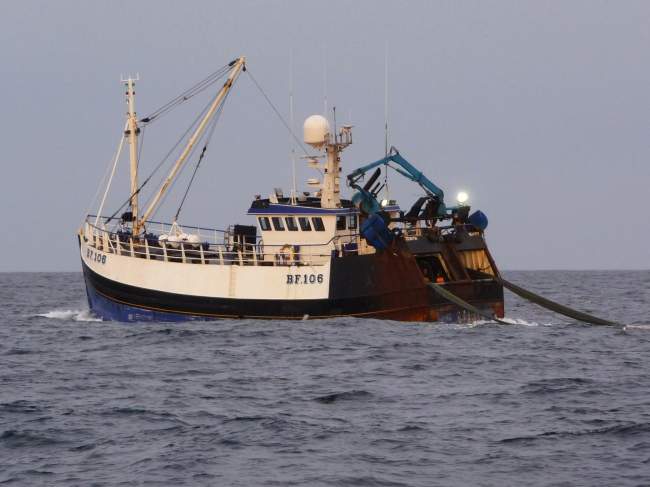
You can make out the new type raft in the first photo, just forward of the wheelhouse, and there would most likely be one on the side opposite.

Click on the photos to enlarge them and give you a better view.

Quite a contrast.

Enhanced by Zemanta

Monday, 25 April 2011

How times change.


I placed some photos in "http://www.trawlerpictures.net/index.php," a sight where I can go to view pictures from the past and present of fishing boats that can usually conjure up memories that had been lying dormant at the back of my mind for years.

After receiving a comment on a photo I placed in it, of me throwing the dhan away while I was on the Olive Tree in the sixties, with the seine net ropes stacked on the deck from stem to stern on both sides, I had to think again of the changes I saw on the boats during my time at sea.

The guy had remarked on the ropes, and the work involved in stowing them, and how hard the work must have been for us in comparison to the present day and his time at the seine net.

We went from standing at the coiler in all weathers watching the ropes pile up underneath it, then haul them away and stow them along the deck, or if we were among fish, running between the coiler while gutting and washing fish, lowering the baskets into the hold, and in some cases where I was concerned, jumping down the hold to box and ice them, to reels that hauled and stowed the ropes for us.

On the odd occasion, cog wheels in the coiler would break and we would have to coil the ropes by hand until the net came up, them we would have to take the coiler to pieces and fix the broken part before we could continue fishing.

At the time we never gave it much thought, as it was all in a days work then, but as I have mentioned in earlier posts, I did used to imagine some of the new inventions and methods that came along which made the job much easier.

No longer are the ropes manhandled or nets hauled by hand, nor are the crews, in most of the new built boats at least, working on open decks.

There are still breakdowns and the crews still have to do as many repairs as they can manage, as there are no garages or engineers out there that they can call into to get things fixed, and a long steam home to get repairs done means wasted fishing time.

When I was at the sea and some of these changes were taking place, although welcomed, we took the progress more for granted, like watching a baby grow. The stages came one at a time, or in some cases when you crewed on a more modern boat the equipment was there and although accepting the benefits you never really took much notice of the change as you were among it all the time.

It is only now, when remarks are made, like the comment in regards to my photo that I can look back in amazement at just what we really went through in comparison to the fishermen of today.

The boats are all closed in, and nets are either hauled by power blocks or net drums, but when I look at the size of nets that are worked now, there is no way we could have hauled them by hand.

The modern equipment has allowed the boats to work bigger and heavier nets, the shelters over the decks have made it safer to work in rougher weather, but the danger from the sea still lurks, and boats and men are still lost.

We did used to get heavy objects in the net, objects that were not only too heavy for us to haul the nets, but also dangerous objects like bombs left over from the wars.
In these cases we would improvise and fleet the net up feet at a time with our lifting derrick which could take hours, depending on the sea conditions and if a bomb or mine appeared we would have to either cut the danger away and take the Decca readings of it, or tow it into shallow water, dump it and alert the Navy who would then send men out to blow it up.
Either way, hours of fishing, or at worst a whole days fishing, plus the net would be lost, costing us a fortune with no compensation coming from anywhere, only the hope of good catches for the rest of the trip to make up for it.

I can visit harbours now or look at photos on the websites and be amazed at the boats now, but I never think, we had it any harder then, because no matter how modern the fishing gets it will never be an easy job.

I can remember my uncle saying to me one day as I moaned while struggling to keep my feet on the deck as I coiled ropes by hand, sea spray thudding off the back of my head and knowing we had the coiler to fix as soon as the net came up, "I don't know what you are moaning about, in the old days the crews had to coil the ropes by hand every haul."

Aye the old days were always worse I thought, but it wasn't any consolation to me at the time, nor will it be any to the boys who still have to go through hell to put fish on our tables.

The only consolation we get or in my case got, was the fact that it was my calling, I loved the job, the adventure each day brought and the variation each day threw at us, be it breakdowns, bombs or big fishing, rough seas or smooth, we were never bored.

I don't know how much more modern equipment, or how many more changes will come and improve the fishing industry, but I do know some skipper in the future will say these words to one of his crew when things are getting him down, "I don't know what you are moaning about, you should have seen what I had to go through when I was a boy!" and the rookies at night will listen in amazement to the tales the old boys will spin of days gone bye,

Some things never change!

Top picture. ( Me at the seine net posing. Open decks, fifty foot boat.)

Bottom picture. (The Zenith trawling all enclosed decks, bigger boat.)


Enhanced by Zemanta

Sunday, 20 March 2011

Delivering the Mail. Postman on his rounds at ...Image via WikipediaAlthough I was quite happy being a postman the adventure part of it left a lot to be desired.

Being bitten five times by dogs, or struggling about in deep snow to deliver the Queen's mail feeling like the last pony express, with the slogan "the mail must get through at any cost" ringing in my ears as I evaded another dog bite or snowdrift, was nothing in comparison to the thrill of punching into a storm in the dead of night with white crests towering above the mast seconds before they came crashing down around you.

The secure relatively safe life of a postman with terra firma beneath your feet, and a steady wage coming in at the end of the week might seem to some people quite idyllic in comparison to rolling about the ocean and holding on every time a lump of sea thundered into your boat drenching everything in site including you.

Not me I was born and bred to the sea and as I drove and wandered around delivering mail I used to recall the days of true adventure on the high seas and thought of the way the European Union had spoiled it all for future generations of fishermen who will probably never be able to capture the large amounts of fish in one haul as we used to do during the cod fishing at this time of year thanks to quotas that have become too restrictive and unnecessary in most cases.

Yes its March again, the month when the cod would come to the Firth of Clyde in large shoals to spawn in the warmer, shallow waters around the Ailsa Craig.

Cold winter days with biting winds howling from morning to night, seas rushing over the deck as we toiled,gutting cod for hours on end, making the most of the good catches to be had while the going was good, because when the cod left to go back to deeper waters the Clyde seem to empty of all other types of fish and a few lean weeks lay ahead of us.

Changing over to trawling for prawns was one option, but we used to tie the boat up and give her a good overhaul and paint in readiness for the summer fishing which would be the next opportunity to make big bucks.

In between times we made a steady living, except for the few weeks after the cod, so all the punishment was worth it when the bulging pay packets landed on the table in front of us.

All the freezing cold hours, hard graft, cut fingers and horrendous conditions were forgotten about as the aroma of beer hit our nostrils when we walked past the extractor fan on the pub window and the thought of a cold pint of lager being placed in front of us that would wash all the salty taste from our mouths and a whiskey to take the chill from our bones.

That was our excuse anyway if we ever needed one, but the first one certainly went down well and hit the right spot every time.

I had plenty of adventures to look back on during my then dull life as a postie, and nothing could or will be able to compensate for the sea.
It seems that you, the readers think the same way by your response to my last post, so if it is sea adventures you want to read about there is plenty more to come.


AH! Thats more like the thing.

After one post about the Royal Mail I have decided to look out my oilskins again and relive more tales of the sea.
If only I could have altered course so easily then I would have been very happy and more content but it was not a viable option at that time
All you faithful readers will be pleased to know that one post was enough of the Royal Mail for me too, so you too can look out your oilskins for the next post.

The Royal Mail? Well that was "The last post."


Enhanced by Zemanta

Sunday, 23 January 2011

A postman's follies.


Royal Mail postmanImage via Wikipedia


I thought I would give you a rest from the fishing and save the best of these stories for my book that is three quarters finished.

I worked as a postman for ten years after I left the sea, so here is some tales from those days.

After working the long hours at sea I used to tell the postmen who complained about their job, that I considered it semi-retirement, it being easy with an eight hour shift in comparison to the dangers and long trips at sea.

In my first year I was to learn that certain dangers occurred at work for postmen too, (And women. Better remember political correctness.) although not producing the more serious consequences that the fishing held should you become lackadaisical while carrying out your duty.

I started in the village of Patna where I had lived for about fifteen years and knew every nook and cranny of it due to the compactness of it,or so I thought, never realising that I had to do the outlying part (farms etc.) with a van, but with training I managed to pick it up pretty quickly.

It took time to perfect the job, boxing in all the mail and delivering it to the correct addresses and the correct streets, plus delivering any parcels after the mail had been dispatched, but as the weeks went on I became very efficient and my confidence grew.

I would hurry my rounds, working out of the van which meant I never needed to carry any heavy bags, not that it would have been any problem to a strapping lad like I was then, but I was glad of the bag on this particular day.

I was scurrying around as usual quite relaxed when I approached a door that I knew a large dog lay in wait to snatch the mail from my hand, but the owner had placed a box behind the letter box, more to protect his mail rather than protect the postman. I always used to laugh to myself at the thought of the dog growling frustratedly as it attacked the back of the door so violently that at times I thought it might manage to barge through it and get to me.

Anticipating the usual melee behind the door I skipped down the path with a twinkle in my eyes, when all of a sudden the Alsatian dog charged from the back garden of the house and was upon me in a flash.
All I could do to protect the private part of my body that it had lunged at with teeth bared and saliva drooling was to put the mail bag in front of them for protection.
It seemed to work but after a savage bite at the bag it took another lunge and grabbed my leg just missing the vital part I had just protected, and it was only when the owner appeared and called it off did it let go and run off.
My defensive instincts turned to anger and the smoke began to steam out of my ears as I stupidly chased the animal down the path from whence it came, swearing to kill it and its owner if I managed to lay my hands on them.

With the dog locked safe in the house again (not sure if it was safer for me or the dog at the time)I turned my anger at the owner who threatened to report me to the post office manager.
"ARE YOU STUPID!" I shouted, "I am reporting you and your dog to the management and you will be lucky if both of you are not put down, the dog with the vet and you by me!"

That is the mild version.

With that I returned to my van, and it was then that I saw the blood seeping through my trousers, so I made a hasty retreat to the local post office to report the incident myself.

Jim the postmaster there, was on the phone when I entered and lo and behold it was the owner of the dog complaining about my language, and while listening to him, tried to calm me down as he had observed how angry I was and knew the cause of my anger was at the other end of the phone.
When he got off the phone he told me to go the the doctors for a tetanus injection and not to worry about the owner of the dog as it was him and the dog that was at fault.
Well, worrying about any threat from them was the farthest thing from my mind but I did calm down by the time I reached the doctors, and with the evidence from the bite on my leg for the doctor to witness, the police paid the owner a visit.

I was told by them after, that a dog is allowed one bite and if it repeats the deed, only then will it be put down.
The wound healed fine after a couple of weeks but the deed festers inside me to this day, and I detest dogs. (My apologies to responsible dog owners.)

I blamed the owner as much as the dog and once I had calmed down I never really wanted the dog destroyed. As for the owner weeeeeeeell I had to think hard about that one. ha ha.
You would have thought it would have taught me to be more careful in the future, but during my first year as a postman I was bitten five times of which I might divulge the details to you next time, but you will understand why I was not over the moon when my niece announced recently that she had purchased a puppy as a pet for her children. ha ha

Puppies grow into dogs and postmen become a hate figure of them simply because we invade their territory,or so they tell us during training, but it is hard to convey a message to a dog that is hanging off your leg that you are only trying to deliver a letter to their owner.

Nowadays its usually junk mail or bills that is delivered, so who can blame the owners now, if they allow their dogs to chase the poor postman who, after all is only doing his job, a thing the owners should remember, including my niece,if they love their dogs, as the consequences could be grim for both the postman and their dogs.

As for my temper...................MY BARK IS WORSE THAN MY BITE GRRRRRR!

Top photo (Me in my postman days with a budding helper.)


Enhanced by Zemanta

Thursday, 23 December 2010

Gentle summer breezes.


In contrast to last months post I thought with the severe winter weather we are experiencing in Scotland I would warm the keyboard of my computer recalling the unusual days at sea when the surface of the ocean was flat clam shimmering like glass on a wind free sunny summers day.

The summer days are long in Scotland with the sun rising between three and four in the morning and setting around eleven at night with hardly any darkness in-between.

We would leave port at midnight on the Sunday night when darkness had just fallen, but if the moon was at a point in its cycle where it shone large and bright in the sky, it appeared as if it was still daylight and you could see for miles over the silvery sea.

When I was on watch on mornings like these I used to soak up in amazement the beauty and variations of colour mother nature could conjure up to create the fantastic sea scape that lay before me as we sliced our pathway across the sea of glass to the fishing grounds west of Pladda lighthouse at the southern tip of Arran.

It was the fishing grounds there, that Hake were caught in the warm summer months when they came into the shallower waters to spawn, providing us with rich pickings as they were one of the most expensive fish we landed, being savoured by the Spaniards who travelled all the way to Scotland to buy them in bulk and ship them back home.

The crew were rallied when we reached the fishing grounds just before daylight appeared in the eastern sky and the dhan would be thrown over the side where two miles of rope were shot out, then the net, as we turned and shot out two more miles of rope on our return to pick up the dhan and begin our first haul of the day.
It took two hours to complete the tow and once the net approached the stern of the boat we would stop the winch, tow it along the surface to assist the cod end that held the fish to float on top of the water before we started hauling it aboard.
It was when we came astern to haul the net aboard that the cod end would reveal its contents by floating a silvery blanket of bloated hake bellies along the bag and as we pulled it towards us they would rumble down into the cod end, then be lifted aboard by the derrick, spilling into the pound where we would quickly box them ready to gut.
In the case of the large Hake we would gut them straight from the pound once the gear was shot again as the majority of them were usually longer than the boxes and with their girth it did not take many to fill a box.

We would still be working with the fish as the next haul was in progress, and the mud from the ropes coming in would splash all over us and the deck, covering all in its vicinity with a thick layer of brown clay as it dried in the now rising sun which became warmer with every passing hour.

As early as 9am it would get so warm that I used to cut down an old oilskin and make an apron out of it, tie it around my waist to keep the lower half of my body as dry as possible while I stripped to the waist and let the sun beat down on my pale skin, hidden from the elements all winter beneath layers of clothes during the cold stormy days that was more normal to us than the balmy weather arising from the few hot summers days we might be blessed with.
All day I would work like that only donning my full oilskins whilst hauling the net to protect myself from the scaulders that fell on our heads from the net as it was drawn through the power block (scaulders are red jellyfish that appeared during the hot weather and had a sting like vinegar or salt hitting an open cut)the term scaulders coming from the burning feeling they gave you when they landed on sensitive pieces of skin around the eyes or open cuts.
(SCAULD meaning to burn in Scots lingo)


By the end of the day when the sun set below the horizon my back was as red as the scaulders, and also would sting in a similar way, having had too much sun at one go, and even though this happened every year I still never learned from it, always desperate to grab some sun while the chance was there and willing to suffer for it, as after a couple of hours sleep at night it seemed to cool down enough to start the process all over again if we were lucky enough to have sunshine two days on the trot.

The job was so much easier and less tiring on calm seas, no rolling and pitching about or holding on to boxes of fish as the boat was thrown violently in all directions, and calm seas also allowed us to stand without having to think about where to place our feet or correct our balance as we did in storms during every lurch our vessel took.

As the sun rose in the east it would paint a different picture of colour every morning depending on the atmospheric conditions or slight cloud formations that might feather the pale blue sky. At night when it sank like a giant red ball of flame beneath the west horizon into a flat calm sea you almost expected it to sizzle and steam when it appeared to touch the surface as it flickered shades of pinks and lilacs that danced among the few ripples stirred up by the tide and evening breezes, cooling the night air slightly, giving us a short respite from the heat that would soon burst upon us again come morning.
As the day wore on I would drench myself with the cold salt water pumped from the sea through the hose that led to the deck just to cool down a bit, and come the end of a trip my hair was like wire when I went to wash it,having to use handfuls of shampoo before I could work up enough lather to cleanse the salt from it.

Wonderful sights of mother nature to behold during the long days of summer in Scotland, but as the calm days dragged on with steam rising from the decks and the fish too as they lay in wait to be gutted, by the heat of the sun beating down, mingled with the build up of heat on the deck from the engine room, meant we had to be quick attending to them and get them in ice before the heat affected the freshness of them, losing us money come landing time.

We had a good crew in those days so the problem of rotting fish never arose and we always got top money for our fish no matter what the weather threw at us, but once the calm days turned into weeks the novelty began to wear off and we would wish for a stiff breeze at least to liven things up again.

When the calm days became tedious I used to think that it must have been the same for sailors of old who, when lying becalmed would have been bored as they waited to move forward having had to rely on wind and sail power to drive them onward to their destination. Whereas they would be willing the wind to blow for that reason, we began to wish for wind to relieve the boredom the calm seas and the heat caused us as we toiled under the burning sun all day.

Then one morning you would sense a change working in the weather, as the sun rose with an angry looking sky, and the gentle cool summer breeze getting colder instead of warmer with each foot the sun rose above the now grey horizon, whipping up the once calm sea into the turmoil we were more used to.

The boredom had passed, the long oilskins were donned for the day and the now tanned skin on my back was once again hidden from the elements leaving only my hands and weather beaten face uncovered, where the spray from the rising waves would leave its mark as it hammered across the deck with each dive we took into the deepening troughs.

The long summer days were over, the fishing had its good points, and the beautiful visions of mother nature I witnessed during these special sunsets and rises will never leave my mind, a wonder to behold indeed.

The days would get shorter as the sun rose later and set earlier, displaying a different kind of beauty through cold angry winter skies, but as our vision was impaired by lumps of sea crashing around us and our concentration focused on the dangerous task in hand of casting our nets, clearing the decks and keeping our balance, making sure we were not thrown overboard, we could not take the time to appreciate them so much, but then again that was what we expected and looked forward to when we signed up, a bit of excitement and adventure that helped to keep our wits about us,preserving our lives as we unwittingly collected stories along the way that might come in handy to tell our grandchildren some cold snowy December night gathered around the glow of a warm log fire before we watch them snuggle down to sleep to dream of the gifts Santa might be bringing them through the storm.

I have retired now as my regular readers will know and although I have no grandchildren of my own to relay my stories to, I do have my followers, and I am sure some of them might just be reading this before they fall asleep to dream of the gifts Santa will be bringing them regardless of their age, so I hope when you awake your dreams have come true.
If they don't you must have been naughty ha ha.

MERRY CHRISTMAS AND A HAPPY NEW YEAR.

I wish to thank all my readers and followers for their loyalty, and for their fantastic comments during the past year.
I wish you all great time on Christmas day and all the very best for the year ahead.
Enhanced by Zemanta

Tuesday, 9 November 2010

White horses.


Gulf stream mapImage via WikipediaThe past couple of days have seen cold easterly gales blowing across Britain which brought back memories to me of numb hands, spray from the salt water, freezing as it landed on the deck, stinging my face as it battered into me while fishing off the west coast of Scotland.

It was mostly south westerly winds that we had to contend with which blew from the open Atlantic Ocean causing huge waves to build up as they journeyed across that vast expanse of water making our job all the more difficult and dangerous than it already was, so you would think that when the wind blew from the east it would make life more bearable for us,.................. not so.

Southwest winds reach us on the Gulf Stream, coming from the region of the Caribbean Sea and although they bring plenty rain and storms they are quite warm in comparison to easterlies, as the easterlies come from the frozen Baltic climates mostly in winter bringing snow and ice.

It shows that there are hazards to fishermen regardless of which way the wind blows, as while some shelter can be gained with the wind blowing off the land creating smaller waves, these waves have what we called "white horses" at their crest which break constantly over our bows and across the deck when steaming and carrying out our tasks on deck, so much so, that we spend the day soaked to the skin with freezing water running through us even though we have oilskins and sea boots on.

The day begins in the early hours of the morning when we are about to sail, hauling in mooring ropes that are thick with ice and cannot be coiled, so we have to manage them as best as we can until we leave the fresh water of the river Ayr and reach the salt water of the sea where the ice slowly melts enough to allow us to coil and stow them safely.

The icy wind will be howling and the rigging rattling and shuddering as we plough our way through the sharp seas with spray and spindrift blinding our view at times, but with the reasonable shelter we get from the land, the seas are workable, so another day of hell begins.

Although you are not diving into deep troughs, the boat ploughs on into the sea like hitting brick walls, throwing the icy spray across the deck and when it hits your face it feels like nails being hammered into your skin, so you try to keep your head down as much as possible, but it is not so easy to do when you are among shoals of fish that need gutting and washed just like any other day.

Our hands, like our faces become leathery and hard, which is just as well, but that did not prevent the blood to stop reaching our fingertips or other extremities when it got extremely cold, leaving our fingers numb when standing gutting the fish, our feet, feeling as cold as the lumps of ice relentlessly thudding into us each way we turned, as if bullets from a machine gun were being fired at us from the constant freezing spray that showered over us and swirled around our feet.

When our hands are as cold as this you feel no pain, barely feeling the knife you are holding, so it is easy to cut you fingers which happens on a regular basis and the blood, if any, is mingled with that of the fish, so it is not until you wash your hands allowing the blood to flow freely again, once the decks are clear that you see blood pouring out of a wound that might need attention.
Our hands are always covered in cuts, the cuts are usually in the same places where the knife cuts the guts of the fish against our thumbs, or on the opposite thumb where we hold the fish by the gills slicing down its belly turning the knife back up to scoop out its innards after severing their stomachs,sometimes slicing our own fingers along with it.

Justice some might say, but as long as people want to eat fish, mankind will catch them.

Even with badly cut fingers the work goes on, and during the winter months when the easterlies blew, haddocks were the mainstay of our catch.
The haddocks fed on shellfish that lay on the seabed which meant that their stomachs were full of sharp pieces of shell still digesting in their bellies, and during gutting the shells would rub away the skin between our fingers until they too bled, and at the end of the day our hands were in a sorry state.

When your hands warmed up between hauls the blood would slowly come back to the tips of your fingers which brought pain of a different sort, not knowing whether to laugh or cry or where to put your hands to ease the agony somewhat, which was nigh impossible anyway. It was a pain that is hard to describe but if you have ever smacked an object hard with an open hand, or received six of the best with a strap from your teacher at school, multiply that pain a hundred times.
If you don't believe me and want to experience it, lift a block of concentrated ice,(not really advisable) and if it doesn't stick to your hand the blood will immediately rush to your fingers, to combat the sudden cold, creating a burning effect and as it surges to the tips it will give you the excruciating pain we went through every day when the easterly winds blew in winter.
(I was stupid enough to lift a block of concentrated ice when I was young, so I know what I am talking about.)

Gloves might have been a good idea, but they slowed us down too much when working with the fish, even so, your hands still got numb in them anyway, and as it turned out, our hands became tougher then any glove we tried.

When sailing time came again, we tumbled out of our cosy bunks straight into the icy blast of wind howling through the rigging, the corrugated iron roof of the fish market rumbling in the wind as it threatened to take flight. Our hands were stiff and sore as they had dried out overnight leaving them tender to the touch until they were saturated in water again, and when we let go the iced up mooring ropes we could hardly bear to touch them as we hauled them aboard, then out into the white horses where the torture would all begin again.

My party trick when I was ashore among landlubbers was to stub cigarettes out on my hand to show how leathery they were which always proved popular, and drew gasps from the ladies.
Yes I was proud to be a fisherman, following in the footsteps of my grandfather, and I knew I had to take the good with the bad, be it high seas with deep troughs or cold easterlies with their white horses, we consoled ourselves thinking of the warm summer days ahead, or the thought of downing a stiff whisky when we hit the pub.

I had to live and work in conditions that horrifies shore workers and in conditions that I would not be allowed to work in if the strict health and safety laws ashore applied, but then again if ever they were applied there would be no fishermen, because there is no way we can beat the elements regardless of human laws.
Most new boats have decks that are covered over in the working areas making the job much easier, but even shelter decks, though they might divert the freezing wind from your face, won't prevent the cold from penetrating your body when the easterly wind is screaming through the rigging.

I have been retired for some years now, given up smoking and trying to impress women, but my memories of those cold stormy days are still vivid, and are rekindled when the easterlies blow. Sometimes even when my hands feel cold when working at the sink under the cold water tap, I begin to wonder why my face is still weather beaten and leathery whereas my hands have softened somewhat, but you still will never get me to wear gloves, especially the yellow marigolds that the women wear.
I might not be as tough as I used to be, but I have not gone completely soft. ha ha.
I would rather grin and bear it just like the old days, and although I don't cut myself so often, my hands still bear the scars from yesteryear, a reminder to be careful when using knives.

Enhanced by Zemanta

Tuesday, 28 September 2010

For those in peril on the sea.

Lifeboat Day in Coverack.Image via WikipediaYou would think that the vast open sea could handle all the ships of the world and would be safer than a busy motorway, but the consequences of a collision at sea can have more serious results than a fender bender ashore, and in certain channels shipping gets quite congested at times.

In the busy shipping lanes of the world great care is taken by the coastguard and the captains of the ships to avoid any such event, but they do happen, normally in rough weather or fog, hence the need for our valuable rescue services like the lifeboat, coastguard and air sea rescue helicopter units.

In the quiet waters off the west coast of Scotland, the few ships that pass by are made up of coasters, ferries, the odd oil tanker heading up to Greenock, and on the very odd occasion a cruise liner will visit the beautiful area in and around the Firth of Clyde.

Gone are the days of John Browns shipyard turning out ships and them seen doing their trials along the measured mile where the great Queens, Mary, Elizabeth and Elizabeth 11 graced the waters of the Firth before heading off to travel the world providing luxury cruises to all who sailed in them.

There are still some navy ships being built at another shipyard on the Clyde, and they still do trials out there, also the Royal Navy does exercises in the suitable deep waters around Arran at times adding to the traffic, with some submarines to be had too, so all in all, as at anytime and anywhere at sea strict vigilance is required at all times.

Sadly even though we have many modern navigational aids the human element is still the most reliable but also the one that makes the most errors, and is the cause of most collisions or tragedies at sea.

Taking your eye off the ball even for a second, as on the roads, can mean life or death as you have to be wary off all around you,like weather conditions that can change at the drop of a hat, or shipping appearing from the horizon that has to be noted and its course, speed and direction observed as it could interfere with your plans before you realize it, especially if you are towing fishing nets astern of you which makes manoeuvrability almost impossible, so you have to anticipate the hours and minutes ahead not just the seconds that are needed on the roads.

On more than one occasion I was unfortunate enough to be at the mercy of the human element in command of a ship, or small coaster as was in these cases, but none the less scary than a tanker when it is bearing down on you on a collision course, us unable to take evasive action while fishing and able to see the man in command having a conversation with his shipmate unaware they were heading straight for us and contact only seconds away.
Shipping is supposed to give fishing boats a wide berth and every fishing boat has signals to show it is working and cannot manoeuvre, a rule of the sea, just as you still give way to a boat under sail.

Having sailed on fishing boats from forty foot up to over seventy, I always thought the boat was big, in comparison to what, I am not sure, but when you are aboard it seems that way, so you think that you are clearly visible to any passing traffic who should be keeping a look out, "WATCH" being the operative word as it is called a watch when its your turn at the wheel when steaming or towing whatever the case.

Obviously the man on watch in this case had never looked at his radar never mind looked out of the wheelhouse window as he was completely oblivious to us. It was the seconds before impact that you realize how small your boat really is, and it is also amazing how quickly your brain works when you are put in such a predicament.
My first thought was to jump on the anchor dangling from the bow of the coaster, it looked easy at the time, but with hindsight, foolish, everything seemed to go in slow motion the nearer the coaster came to impact us and it gave me time to run forward to the winch and release the brakes, letting our gear run out and giving us enough forward thrust to slip under the bow and into the wash of sea it was pushing in front of it.
As soon as the man on watch noticed our mast he took evasive action by turning the wheel hard to port and scrapped past our quarter with inches to spare, avoiding the collision that would have halved our boat in two.
Without even an acknowledgement he sailed on and over the horizon without a care in the world leaving us to recover our nerves, haul the gear back to where it should be and continue fishing, although it took a strong cup of tea and about ten cigarettes before my nerves settled.

That was the closest call I had, one other being an idiot in a small but larger coaster heading straight for us, aware of what he was doing, his way of giving us a fright, which worked, but I would like to have seen his face when the Board of Trade officials boarded them when they docked as we reported the incident, and it would have been taken very seriously, punishment also dished out to idiots and law breakers at sea, just as on land.

There were a few other times when we had to take evasive action with arrogant captains not wanting to stray from their course to avoid small fishing boats that would seem only an irritation to them but had we not anticipated their actions the consequences would have been severe, not only to the crew on the fishing boat who would have landed in the water, maybe even drowned, but for the irresponsible captain who would have lost his rank, which would have been more than irritating to both parties.

All my near misses happened in clear weather, but some of my colleagues were not so lucky, some lost their lives, which I would rather not go into, but will tell you of one particular boat with close friends of mine aboard who were run down and sank one foggy day.

It was a small coaster, the same one that gave me my closest call, obviously a lesson never learned, although fog is one of the worst things you can experience at sea even with all the modern equipment like radar.

My friends had been fishing at the west side of The Alisa Craig, a notorious place in fog where the island disappears and the haunting sound of the foghorn can be heard for miles around.
They had their gear aboard and were steaming between tows so both skippers were to blame, but nonetheless both skippers got a shock when the coaster appeared out of the fog ramming the "RANDOM HARVEST" amidships sending her to the bottom in minutes.

One of my friends was in the wheelhouse with the skipper and told me, "He appeared out of nowhere, never showing up on the radar nor his foghorn heard."
Strange, but fog does have a weird effect at sea and strange unexplainable things like that do happen.
Another friend of mine who was in the hold packing fish at the time, felt the impact and when he scrambled up the ladders to get to the deck, the boat was going down as fast as he was trying to get up.
Thankfully, after a short swim, all were rescued by the crew of the coaster, "THE SUNLIGHT" of all names, but I often wondered what would have happened to me had I been on the Random Harvest as I could not swim all the years I was at sea only learning some years later.

Storms were not the only factors to create danger at sea, fog and the human element were another two, the human element being the one that should never be in the equation but is most likely to be the worst offender when it comes to collisions.
Accidental the collision might be, but negligence is most likely to be at the root of it, and as on the roads, that split second can mean life or death even though there is a vast expanse of ocean.

"GOD BLESS HER AND ALL WHO SAIL IN HER"
Is the quotation used when a ship or boat is launched, and every sailor I know have needed God's blessing at sea at one time or other, be it through storms or stress, rough and ready we might be, we have all turned to him at some point, some luckier than others, some living to tell the tale, some not.

I have great respect for the sea, and after all the years spent on it, knowing what it can throw at you, I have every respect for all the men and women who still go down to the sea in ships, but more so for those of the rescue services who put their lives at risk to save us should we flounder in any way.

Although there is a vast expanse of ocean, with many open spaces, it still provides much more danger than any of our congested roads ever will.

Enhanced by Zemanta