Showing posts with label Seine fishing. Show all posts

Monday, 25 April 2011

How times change.


I placed some photos in "http://www.trawlerpictures.net/index.php," a sight where I can go to view pictures from the past and present of fishing boats that can usually conjure up memories that had been lying dormant at the back of my mind for years.

After receiving a comment on a photo I placed in it, of me throwing the dhan away while I was on the Olive Tree in the sixties, with the seine net ropes stacked on the deck from stem to stern on both sides, I had to think again of the changes I saw on the boats during my time at sea.

The guy had remarked on the ropes, and the work involved in stowing them, and how hard the work must have been for us in comparison to the present day and his time at the seine net.

We went from standing at the coiler in all weathers watching the ropes pile up underneath it, then haul them away and stow them along the deck, or if we were among fish, running between the coiler while gutting and washing fish, lowering the baskets into the hold, and in some cases where I was concerned, jumping down the hold to box and ice them, to reels that hauled and stowed the ropes for us.

On the odd occasion, cog wheels in the coiler would break and we would have to coil the ropes by hand until the net came up, them we would have to take the coiler to pieces and fix the broken part before we could continue fishing.

At the time we never gave it much thought, as it was all in a days work then, but as I have mentioned in earlier posts, I did used to imagine some of the new inventions and methods that came along which made the job much easier.

No longer are the ropes manhandled or nets hauled by hand, nor are the crews, in most of the new built boats at least, working on open decks.

There are still breakdowns and the crews still have to do as many repairs as they can manage, as there are no garages or engineers out there that they can call into to get things fixed, and a long steam home to get repairs done means wasted fishing time.

When I was at the sea and some of these changes were taking place, although welcomed, we took the progress more for granted, like watching a baby grow. The stages came one at a time, or in some cases when you crewed on a more modern boat the equipment was there and although accepting the benefits you never really took much notice of the change as you were among it all the time.

It is only now, when remarks are made, like the comment in regards to my photo that I can look back in amazement at just what we really went through in comparison to the fishermen of today.

The boats are all closed in, and nets are either hauled by power blocks or net drums, but when I look at the size of nets that are worked now, there is no way we could have hauled them by hand.

The modern equipment has allowed the boats to work bigger and heavier nets, the shelters over the decks have made it safer to work in rougher weather, but the danger from the sea still lurks, and boats and men are still lost.

We did used to get heavy objects in the net, objects that were not only too heavy for us to haul the nets, but also dangerous objects like bombs left over from the wars.
In these cases we would improvise and fleet the net up feet at a time with our lifting derrick which could take hours, depending on the sea conditions and if a bomb or mine appeared we would have to either cut the danger away and take the Decca readings of it, or tow it into shallow water, dump it and alert the Navy who would then send men out to blow it up.
Either way, hours of fishing, or at worst a whole days fishing, plus the net would be lost, costing us a fortune with no compensation coming from anywhere, only the hope of good catches for the rest of the trip to make up for it.

I can visit harbours now or look at photos on the websites and be amazed at the boats now, but I never think, we had it any harder then, because no matter how modern the fishing gets it will never be an easy job.

I can remember my uncle saying to me one day as I moaned while struggling to keep my feet on the deck as I coiled ropes by hand, sea spray thudding off the back of my head and knowing we had the coiler to fix as soon as the net came up, "I don't know what you are moaning about, in the old days the crews had to coil the ropes by hand every haul."

Aye the old days were always worse I thought, but it wasn't any consolation to me at the time, nor will it be any to the boys who still have to go through hell to put fish on our tables.

The only consolation we get or in my case got, was the fact that it was my calling, I loved the job, the adventure each day brought and the variation each day threw at us, be it breakdowns, bombs or big fishing, rough seas or smooth, we were never bored.

I don't know how much more modern equipment, or how many more changes will come and improve the fishing industry, but I do know some skipper in the future will say these words to one of his crew when things are getting him down, "I don't know what you are moaning about, you should have seen what I had to go through when I was a boy!" and the rookies at night will listen in amazement to the tales the old boys will spin of days gone bye,

Some things never change!

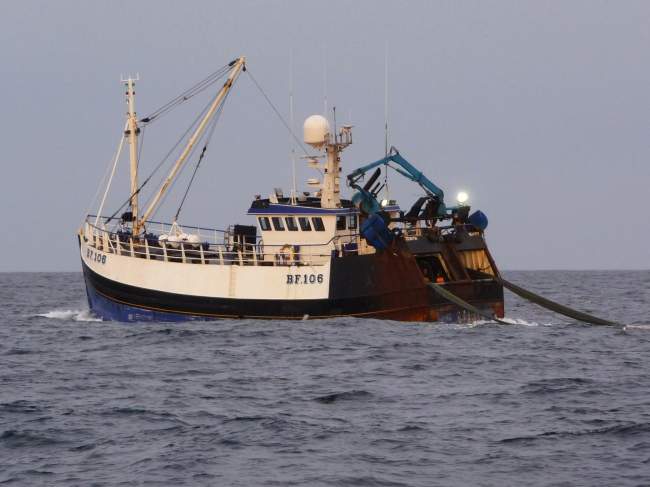
Top picture. ( Me at the seine net posing. Open decks, fifty foot boat.)

Bottom picture. (The Zenith trawling all enclosed decks, bigger boat.)


Enhanced by Zemanta

Friday, 2 April 2010

Breaking the law.

Fishing down the food web, a North Sea perspec...Image via Wikipedia

In the seventies so much herring was being caught thanks to new methods of fishing (mainly pair trawling and purse seine netting) with modern instruments in the wheelhouses that showed the skippers where the spots of herring were, how deep they were and gave images of their nets capturing the spot leaving no escape route for the fish.
This was a boom time in all methods of fishing with great prices being paid by foreign buyers coming from Europe and Russia, with Russian factory ships lying off the west coast for weeks salting and curing herring until they were full, then head back to Russia while another would take it's place.
Mackerel too were heavily fished in this way but never reached the same high prices as the herring.

So much fish was being caught that the powers that be decided to close the North sea to herring fishing for five years and the west coast for three.

This meant that even the seine netters like the "Wanderer" (the boat I worked on at the time) would have to dump any of that species if we happened to catch them.

Sometimes it was hard to escape spots of herring when fishing for white fish especially as the herring were not being fished for by the herring fleet, allowing them to multiply rapidly, which was the reason for closing the fishing in the first place, although there was no immediate signs of any scarcity of them.

During the time when the herring came into the Firth of Clyde to spawn all the fishing fleet from prawn trawlers to seine netters like us, could catch anything from ten to fifty boxes a day and were supposed to dump them back into the sea where, once being towed inside our nets for hours had no chance of survival, so instead of throwing them back to feed the seagulls and gannets we would land them on the quiet out of sight of the fishery officers who prowled the harbours during landing times.

One day we hauled our net to find it full of good sized herring, about eighty boxes in all, a good haul at the best of times, but the thought of throwing all that fish away at the cost of around a thousand pounds was too much to even consider so we kept it aboard and I boxes it in the forward part of the hold to try and conceal it.

We steamed away from them for an hour and shot our gear again hoping to catch white fish this time, but once again it came up with a good haul of Herring, so once again I boxed them forward in the hold and hid them behind empty boxes and some full boxes of white fish that had been caught earlier on in the trip.

We had a good catch of white fish aboard before the herring started interfering with our trip so with the hold almost full, albeit mostly with illegal fish we steamed for the harbour to land.

Sure enough the fishery officer was on the prowl, and much to our dismay jumped aboard our boat as soon as we were tied to the quay and asked to see what was in the hold.
Confident enough that the herring were concealed we opened the hatches and as I looked down onto the floor of the hold from the deck, all I could see running down, thick and white the length of the hold was milk (sperm) that was seeping from the male herring, a dead giveaway.

The fishery officer never mentioned it and climbed down the ladder behind me when I entered the hold in preparation to land.
As he looked aft where the bulk of the white fish were stacked, his back to the hidden herring, he remarked on the good catch we had and was pleased that no herring were among them, chatted for a short while then climbed back out again, and went ashore quite happy.
I scratched my head in amazement wondering how he never spotted the milk on the hold floor, or even asked to see the fish in the forward hold, and I still wonder to this day why we were not nabbed.
We landed the herring at night, straight on to a lorry when all was quiet, or supposed to be quiet anyway as ten to twelve boats were all waiting to do the same thing.
The buyers would purchase our fish and send lorries down at night when the fishery officers were off duty, load them up and whisk them away to their factories where they were prepared for their outlets the next day.
The herring were sold at a cheaper price than would have been had they been sold in the markets and bid for, but the rewards were greater for us, as all the money from our contraband was split evenly among the crew, tax free.
"Stoker" we called it, which was managed in some way every week but never in such abundance.

The fishery officers eventually became wise to our game and would patrol the harbour at night, making it more difficult for us, but we always found a way around it by landing at harbours that had no markets but enough room for a lorry to come alongside the quay where we lay and load our catches that way.

In recent years, boats who tried to flaunt the quota laws have been caught and given heavy fines, lucky to walk away with their fishing licences intact, licences that never existed in the seventies but now every boat has to have one, and log every fish that is caught.

All the fun has gone out of the job, and the Klondike days are gone, the fish are getting scarcer, and who knows if it was the illegal fish landed or not, all I know is that I had fun when I was at sea regardless of all the rules.

The adventure is still there, the storms still have to be contended with, and the fish will recover, as the fleet has been cut drastically, I only hope that there will still be a Scottish fleet to enjoy the bonanza when they return, and the European Union has not damaged it enough that only foreign boats are left and allowed to plunder our waters, and clean them up the way they ruined their own.


Reblog this post [with Zemanta]

Wednesday, 3 February 2010

You can't keep a good man down.


So much for the threat from the skipper of the Girl Margaret, that he would see to it I would never work at the fishing again, his ego was bigger than his capabilities, as I was offered a job immediately, on a spanking new boat "Wanderer 11" that was due to be launched at the beginning of 1976. Meantime I filled in my time working on one of the top earners that fished out of Ayr "The Terra Nova" until after the launch, making more money at home than I was on the Girl Margaret, so much so that the skipper of the Wanderer kept coming down to make sure I was still wanting to sail with him.

This new boat "Wanderer 11" was more than I could have wished for when dreaming of improving catching capabilities, as it had every mod con a fisherman needed for the job, and was seventy feet in length, with every inch utilized to the full, plenty deck space, and plenty room in the fish room to hold all the large catches we secured in the years to come.

One of these large catches consisted of the "dogfish species" I wrote about in my last post, and in this case we caught over twelve hundred and fifty boxes in one, two hour haul at the seine net.

The dog rope I mentioned in my last post, is a rope that is attached to the cod end, and runs along the length of the net to the tip of the net wing, where we can reach it as soon as the net surfaces, allowing us to handle any such heavy weights like this haul of dogfish, or the bombs I wrote about in earlier posts.

This was our second haul of the day, having caught sixty boxes of dogfish the haul previous, but when this lot appeared we knew we had a different task on our hands getting them aboard than we had before, as they were crammed in tightly all the way down the bag.

Dogfish have very rough skin, and if you run your finger along it from the tail up, you are in danger of drawing blood, as it is capable of cutting into you, also they have two very sharp pointed spikes on their back behind each fin which can penetrate deep into whatever part of your body it happens to come into contact with if you are not careful, the only consolation being, if any, they have no teeth.

The fact that their skin is so rough makes it harder to run them down the bag into the cod end, and there being so much bulk of them this time, it was impossible to move them, so after hauling the first lift aboard with the help of the dog rope, the rest were stuck fast all the way up the bag, with no way of maneuvering them into the cod end for another lift.

We were fortunate that it was a beautiful, calm summers day, or the weight of the dogs would have burst through the net with the surge of the sea. We were also fortunate to have lifting derricks both forward and aft, the one aft used while seine netting, and the forward one placed there for use if we ever went to the herring fishing.

We were lying drifting with one end of the net in the power block, and the other on the deck where the empty cod end lay with no way of filling it, and in between, a mass of dogfish that if landed to the market would fetch enough money to cover our expenses and give us all a very good wage.

The only option we had was to lift the cod end high on the forward derrick, and secure the other end of the net to the stern of the boat as best as we could, then cut the net on the middle of the bag, just enough to let two crewmen stand on the mass of dogfish and throw them aboard manually.

The first two to try it was the youngest members of the crew, who were the lightest among us, also the most foolish, or gullible given their inexperience, did so willingly with a rope tied around their waist, and fastened to the boat..........just in case the net DID burst under the water, and there was a sudden evacuation of dogfish, and men from the net.

This trick worked fine, and as we emptied the bag, by this time taking turns inside the net now we knew it was safe, the catch was soon mounting up on the deck where they were washed, thrown down the fish room and boxed.

By the time we had about half of them aboard, we managed to strap the bag up along the side of the boat between the aft, and forward derrick, and bring the remaining catch to the surface, but still they wouldn't run down the bag, so we had to keep cutting the net, throw the fish onto the deck, temporary lace (repair) the hole we were cutting in the net as we went along, making sure we were safe enough standing on the solid mass of dogfish, and as the day was quickly passing we had begun to steam slowly towards Ayr, to try and catch the market before it closed.

It was quite amazing how well the task went, and we all survived without anyone of us plummeting to the bottom among a shoal of dogfish, but we all did bear the scars of the spikes as they frequently jabbed into us during the procedure.

Not one dogfish escaped, and by the time we reach Ayr most of them were boxed, with the remainder being boxed during landing, over thirteen hundred boxes in all, for just two hauls, but two hauls that took all day, and well into the evening before we were cleared up, ready to mend the net, and sail back to where we caught them.

When the first haul of that next day came up we were all glad to see that it was a pleasant haul of white fish that broke the surface, fish we could handle without standing on top of them while they were still in the bag.

As for the dogfish, we either caught them all that day or the rest scarpered, after seeing the fate of their chums, as we never saw that kind of bulk in one haul again.

The story in the last post happened a few years later, but it never proved to be as difficult as that day, there being less dogfish, and not so crammed into the bag, which allowed us to run them into the cod end after each lift.

The memory of my experience on the Wanderer did enter my head that night on the Boy Peter, and although I suffered with jabs from the spikes, the ordeal, even with the shortage of cigarettes, was nothing in comparison, but the stories are ones I thought I would share with you, letting you know the lengths fishermen go to, and the other dangers they put themselves in to land their catches.

Top photo (The Wanderer 11 in her first year. She was updated on a regular basis with a shelter deck added, and rope reels replacing the original rope bins. Had the shelter deck been added at that time, it would have made our task much more difficult.)

Second photo is of "dogfish" but not swimming in shoals of the amount we caught that day. ha ha.


Enhanced by Zemanta

Saturday, 19 December 2009

My return to Ayr.

ObanImage via Wikipedia

We managed to scrape a wage in the three remaining days, but as expected we changed back to the seine net that weekend, and as one of the crew had packed up the skipper sent me to Ayr in the boats van to try to recruit a good seine net fisherman thinking it would speed thinks up on deck, especially if we found ourselves among the expected big hauls of whiting that was being had up the west coast of Scotland.

It takes about five hours by road from Campbeltown to Ayr when you are driving your own transport(an hour less if you drive a fast car)but the journey has some beautiful scenery, which helps to make it more pleasant, making the trip seem to pass quicker.

On my arrival in Ayr I headed straight for the harbour to catch up on the news, only to be told that the Olive Tree had been sold suddenly, with the crew being given no notice whatsoever.
My uncle, rather than spend money on the boat had been made an offer from an Irish fisherman, and realizing that I had no intention of coming back, decided to accept.
The deal was completed in no time at all, and the Olive Tree had already sailed for its new port by the time I arrived giving me no time for a last look, and the next time I was to set eyes on her was in Peel, on the Isle of Man about ten years later.

She looked completely different with her new tripod replacing the thick foremast, giving ample room on deck for the trawl winch and gallows I had suggested, plus a few other small improvements around the deck, and a new, more powerful engine.
Her name had been changed too (to what I can't remember)but there was no mistaking the lines of her hull, and the wheelhouse that had taken me through so many adventures, and introduced me to the life I had chosen as my occupation.

It was a lucky break for me in the fact that I new one good man I could rely on who had been made redundant by my uncles unexpected move, and so after contacting "Davy," and spending a night at home, the two of us journeyed back the route I had just came over the day before.

The Girl Margaret, and crew were lying alongside the quay ready to sail as soon as we arrived, and in no time at all we were sailing down Campbeltown Loch, round the Mull of Kintyre,and up the west coast to chase the whiting that had been reported by other seiners working among the islands on the rugged west coast of Scotland.

The first day proved pretty fruitless with big hauls coming aboard but most of the catch thrown back because they were well undersize, so we moved further north in the hope that we would come across the shoals that had been reported.

The skipper was one of these guys who thought he was better than he really was, having big ambitions above his station, and expected to compete with boats who's skippers were far more experienced than him.

There is no harm in being ambitious, but it was the arrogant way he went about it that I did not like, and a thing I had noticed about him during our spell at the herring, which had led to some of the crew packing up then, and being replaced by other Campbeltown men who thought the same as I did but were just glad of the job.

My temper had been held in place a few times, but when he asked me to pack the fish a different way in the hold which was not only unnecessary, but totally stupid, and would have made it almost impossible to land them in any sensible order, I gave him a piece of my mind.

I pointed out the flaws in his ridiculous idea, added a few other things that had been gnawing at me, and after a good clearing of the air, normal service was resumed on deck, and in the hold, but I was becoming very unhappy with the setup, and almost dreaded the thought of coming in among the big hauls of whiting that we were heading for.

Even though Davy was a great deckhand, it would take more than the two of us to handle catches like that, with the other two deckhands never going above their own slow pace, so as fate would have it, our winch packed in just as we had the last coil of rope to come.

This meant hand hauling both sides of rope until we reached the net, trying to keep them even, and as many fish in the net as possible.

All went well enough, but it meant us steaming to Oban (the nearest port)to get an engineer down to fix the problem as quickly as possible so we could continue with our trip.

We were told it would take a day, so as most fishermen do we headed for the pub where a good dram was had by all, but things got heated when I tried to explain what was needed from all the crew if we were to hit these big shoals.
It's the wrong thing to do when drinking as the brain never thinks in a logical way, so the Campbeltown men took offence at my suggestion that they speed things up a bit, and me telling them they had been at the job long enough to know the urgency of the work in hand.

It never came to fists but I could see that there was never going to be any harmony aboard this boat again whether drink was involved or not, and that the crew were never going to get any better.

The winch was fixed, or so we thought, because after only two hauls the next day the same thing happened again, so it was back in to Oban to find out what was causing the problem.

On the way ashore after boxing the fish we had caught, I decided I had, had enough, and went into the wheelhouse to tell the skipper that I was packing up, and would be taking the first train out of Oban when we berthed.

He knew my reason without me telling him, but with his arrogance he did not want to accept the fact that I was packing in during a trip, and threatened me by telling me he would see to it that I would never work at the fishing again.

How arrogant is that I thought, he really has got well above his station, so I left the heavy atmosphere behind me in the wheelhouse, and packed my gear ready for a quick departure on our arrival in Oban.

He had plenty time to replace me with another man from Campbeltown before the repairs were carried out, and Davy thought he would see the trip out, but packed up at the end of it, realizing how bad things had become on board without the experience needed for the job.

The Girl Margaret never made a success after that and was taken off the skipper who went back to the prawns with an old boat, plugging away at what he knew best, with a crew that worked their own way, at their pace, which was good enough for the prawn fishing.

Me, well I had a lovely train journey home, and could have kissed the ground I set foot on at Ayr railway station late that evening, arriving home unexpectedly to the family I had barely seen in the last months, and now I could be at home to share christmas with them, which was only a few weeks away.

I had no problem getting another berth on an Ayr boat which I am sure my ex-skipper knew at the time of his threat, and I went on to much better things that I will write about in future posts.

The picture above is Oban.


Reblog this post [with Zemanta]

Tuesday, 10 November 2009

Pair trawling for herring.


The white fish was getting scarce, so with the Girl Margaret, being rigged for trawling as well as seine netting, we decided it was time to change over to the mid water pair trawling for herring, and as the fishing trawler "Alliance" from Campbeltown was a suitable neighbour for us with a similar sized engine, the pair team of Girl Margaret and Alliance was born.

I had never been to the pair trawling, or herring fishing before, so this was a completely new experience for me, but as all trawling methods have the same technique it was going to be easier for me to pick up the job than it was for the Campbeltown crew to learn the seine net, so I did not see any problems there, it was only the fact that we would be working as a pair team that worried me.

The nets used have a much bigger mesh than the bottom trawls, as you can see in at the start of the video above, of mid water trawls being hauled, and the herring catch coming aboard, the video also features clips of some disasters at sea, and "purse seine" fishing boats mentioned in earlier posts, entering port laden with fish.

The other parts of the gear were the same idea other than the tons of chain hanging from the foot rope of the net that aided the wing of the deep net to stretch fully when being towed at speed through the water at the required depth.
The other boat had had the same setup and therefore when one net was shot out (shot by the first boat to come across a spot of herring) the other boat came along side and took a wing, then both boats separated to a distance that kept the mouth of the net open, and run enough wires out to meet the required depth of the spot of herring that had been sighted.
The net was towed between the two boats,while the skippers watched in their net monitors, at the spot of herring being towed straight into the gaping net about to engulf them.

Job done and the gear was hauled back, but once the net broke the surface the two boats had to come together and pass the wing of the net back on to the boat that shot the net, so all the herring would go down the bag and safely into the cod end. (Not an easy task in rough weather as men had to jump back and forth to assist with hauling the net and boxing the herring.)
The boat that shot the net would take the all herring aboard unless there was too much for one boat to handle, therefore more jumping back and forth would take place and the remaining herring landed onto the deck of the other boat, to be boxed in their hold.

The jumping from boat to boat was more to share the workload between the crews, as the profits made from our spoils were shared equally, so it was only fair that the work should be shared.

Our pair of boats were varnished rather than the normal paint jobs you see today, a throwback from the early days of the ring netting boats which were tied up for the lean months, and scraped back to the wood, then had several coats of varnish lovingly brushed onto them by their crews who took great pride in seeing the finished article sailing from port at the beginning of the new season shining like a new pin.

The decks were varnished too which made them quite slippy at the best of times, but when the herring was coming aboard, and their scales, slime and spawn were mixed with the salt water running down the decks, you could barely keep your feet.

The first tow went according to plan, and it was the Alliance who spotted the shoal, so it was their net that went into the water, so when it was time to haul, and the boats came together, I was the first to jump aboard eager to observe my first sighting of herring coming out of the water.
The herring fishing is carried out during the night,and when we hauled the net through the power block (as seen in video) the deck lights were shining all around the sea beside the boat and the Girl Margaret was standing off at a safe distance watching the proceedings, and trying to spot the cod end though the glow to see if the shoal was as big as we had surmised from the sonar soundings.

As the net neared the boat you could see the sea sparkle silver with the scales being threshed through the mesh by the bulk of herring running down the bag, and as it entered the radius of the deck lights, the sea around the boat shimmered silvery from the bag solid with fish.(hence the name "silver darlings" when refering to the herring)

The next job was to get them aboard and into the hold, which meant on the Alliance, landing them on deck above the manhole that leads into the lockers where some of the crew would be standing by to spread them evenly throughout the hold, while we on deck would keep filling the cod end and emptying it constantly until all the fish were aboard.

On man at the winch heaving the cod end aboard, and ME standing forward ready to pull the gun, (a metal catch rather than just a knot) that secured the opening of the cod end once it had swung aboard above the manhole, other men standing aft, held up boxes at the side of the boat, taking care that none of the fish splashed back over the low gunnel's of the boat, designed more in the style of the old ring netters.

The first lift swung over the rail, and once it stopped swinging about and settled I bent down and pulled the gun, "SWOOSH" tons of herring spilled onto the deck taking the feet from me, as my boots failed to grip the deck that had become slippier than an ice rink, sending me flying along the deck on a sea of fish, scales, and water running up inside my oilskins, and only a couple of feet of gunnel to stop me being washed over the side.
I managed to grab hold of the stay that helped secured the foremast, just as the sea of herring thinned enough to let me feel the deck beneath my body again, giving me some control over my destiny.
Gathering myself together I slithered back to my position, soaked to the skin, to hammer the gun shut and throw the cod end back for another fill.
Up she came again, and by this time I could hardly keep my feet to get near the gun, so owing to the fact, that I was already covered from head to foot in scales, water and muck of all sorts I took my boots and socks off and carried on for the rest of the procedure in my bare feet, and each time the cod end opened the herring would swoosh around my feet and up around the legs of my jeans, covering everything in thick scales, but at least I stood firm on the deck with every lift, until the net was empty, and the hold full to the hatches with good quality herring.

We had filled one boat, so we headed off to Tarbert at the north end of the Kintyre Peninsula, on the north side of the Kilbrannan sound where we had been fishing, allowing me an hour and a half to get cleaned up before we started to land.

We all had a good laugh at the nights events, happy in the knowledge that for one nights fishing we already had a decent weeks wages secured, and the problem of the slippy varnished deck would be solved by placing a long rubber mat across the deck where men would be standing.

The Girl Margaret had no such problem as the varnish on her decks had been well and truly rubbed clean with all the work at the seine net, and her gunnel's were twice the height of the Alliance's, so when it was our turn to take the herring aboard the following night the job was much easier.

We had the boat laid out in a way that when the herring came aboard they ran through the manhole onto a chute directed at a table where the crew would be standing with boxes at the ready to be filled, and stacked in the hold,(see video)which made it easier to land the herring, also it kept them in a better condition, as there was not the pressure put on them as they lay pack together the way they were in the Alliance's hold.

Although the Alliance was a fairly new boat she had been built in the style of the old ringers, with a fo'c's'le (which is forward) instead of a cabin (which is aft,) giving her a large hold, but with less headroom to carry out the task of direct boxing, the way we could on the Girl Margaret, having to settle for carrying them in bulk to port, and shovel them into boxes during landing, all leading up to a lot of unnecessary work, also there was the problem of the slippy decks, and very low gunnel's.
From then on if it was possible we carried the herring, which pleased William from the Alliance, who jumped at the chance to get aboard our boat especially nearing meal times as we had a great cook aboard, and you were always guaranteed a slap up feed after the herring was stowed away and we headed to the market.

One such night the cook shouted down the hold to us when we were under way and readying the boxes to land, (around five in the morning, as we worked during the night, as I said) asking what we would would like for breakfast,( herring, kippers, or bacon and eggs etc.)

Thinking on my usual time of heading to market at the seine net, late afternoons, I jokingly shouted back "a fish supper would be great", William laughing and agreeing with me, but expecting bacon and eggs to be waiting when we reached the galley an hour later.

When we sat down a large plate of fish and chips was placed before us, the white fish having come aboard among the herring, and the cook taking us at our word, had prepared a brilliant dinner for us to consume in the early hours of the morning.

I must say even at that hour it went down a treat, but the next time the cook asked us what we wanted for breakfast we made sure it was breakfast we ordered, as the fish supper lay heavy in our stomachs during landing, giving us both bad indigestion. Punishment maybe for trying to take the mickey out of our wily old cook.


Reblog this post [with Zemanta]

Tuesday, 3 November 2009

Island wedding.


During the few weeks of the hake fishing I managed to spend the weekends at home, returning to join the Girl Margaret by sailing from Ayr on the Alkaid on a Sunday night, and jumping aboard the Girl Margaret at sea when we met up on the Monday morning at the fishing grounds.
It was an easy enough task in calm weather but in rough seas you had to be extra careful to time your jump on the up surge of the boat, and pick your spot to land on the deck, because if you mistimed it, and jumped on the down surge, you would be more than likely to land in the water. It was tricky anyway you looked at it really, but I was lucky enough to judge my moments correctly, and always managed to find a firm deck beneath me every time.

By the end of August, the hake was beginning to move back to deeper waters, and the catches were getting smaller, while the weather was getting rougher.

The last week of the hake fishing we landed our midweek catch in Ayr, but as the wind was blowing strong from the west come Thursday night, the skipper decided it was wiser to land in Campbeltown, and not risk the rough seas we would have to entail if we headed across to Ayr.
The fish would be sent by road to Peterhead market as the market in Campbeltown was poor owing to the lack of buyers, and of course it meant me spending my first weekend, away from home for a long time.
I could have travelled home by road, but the very thought of the journey there and back filled me with dread, plus the fact that playing the family man was beginning to wear a bit thin, I am sorry to say, and the little break in Campbeltown seemed to come at the right time.
I had a good weekend ashore, and rather than being stuck on the boat as I expected, I was shown great hospitality in the home of one of the crew, where I could bath and have all the comforts of home before hitting the town on the Saturday night.

Money was sent home to keep my house and family, and a quick phone call seen everything else was fine, telling my wife I would be home the following weekend, but as it turned out this was not to be.

With the hake fishing almost finished, the skipper decided to leave early on the Monday morning and head round the Mull of Kintyre, to the sound of Gigha, where he had heard a good fishing of whiting was to be had.

Now this was one move I had been dreading, as this crew working among large fish was bad enough but trying to clear up boxes of small fish was going to be a tremendous struggle with the speed they gutted at,and if the reports were true we were in for big hauls.

The first haul that came aboard was a full lift, about twenty boxes, but it was a mixture of various small fish that had to be hand picked into boxes then gutted.(the undersized fish thrown back, along with the pout fish, a fish that fetched no money)

They were that slow getting the work done that most of them had still to be gutted by the time the next lot came aboard, which was about the same kind of bulk, and the crews I was used to would have had them all gutted and packed in ice and ready for the next lot to come aboard.

Seeing that this way of working was only going to cost us money I suggested to the skipper that we round the smaller fish (land them ungutted which meant less money but at least we had the chance of getting the deck clear) and just gut the larger ones.
He agreed, so the work went a bit faster, but instead of just small whitings coming down in the baskets rounded there was all sorts of fish among them including the pout which should have been thrown away.
Double work as I had to pass them back up to be sorted properly or we would never had got them sold.
By the end of the day we had fish on both sides of the boat lying in boxes with mud from the seine net ropes splashing onto them waiting to be gutted and although they were away from the heat of the engine they were beginning to get soft.
It was well after midnight by the time we got everything cleared, iced and boxed, and we were sailing in two hours again, to start all over.
I gave the crew a good lecture before we turned in for the little sleep we would catch, telling them if this continued it would be a waste of time catching any fish.

When you are used to good crews it is very hard to take, seeing the job being abused in this way, and the catch taken so light-heartedly, the fishing was no place for lack of commitment.

The next day the fishing was poor, and for once in my life I was glad, maybe I could knock them into shape when I had less work of my own to concentrate on, so I went through every stage with each and every one of them, showing them how it should be done, until finally they got the message, still not as good as the crews I was used to but a vast improvement.

We were all clear when we tied up at the same pier on Gigha as we had done the night before, but this time it was much earlier,and as I said the work was all done, so I was looking forward to a good nights sleep to ease my aches and pains.

The navigation, and deck lights were no sooner switched off when the noise of a car engine came roaring down the road that ran along the top of the small wooden jetty we were lying at, and stopped at an abrupt halt not far from the boat.

The crew of the Girl Margaret were well known by all of the small community on the island as they had lain there many a time during there prawn and herring days, and had given fish to most of the islanders at one time or other.

Today was a special day though, as we soon found out, when the young man who was driving the car jumped out and shouted, "come on ashore boys you are all invited to the wedding."

Before I knew it we were all hustled ashore, and although had managed a wash we were still in our sea boots, and working clothes (plus three days growth on my chin) and being driven back along the road the car had come from.

On the way a bottle of whisky was produced from under the drivers seat, by the driver while speeding along this narrow road, and passed around to get us in the party mood, as the wedding ceremony was passed, but the celebrations were about to begin.
No policemen were stationed on the island, and when they did pay a visit they had to come by ferry, which meant, before they reached the island everyone knew of there imminent arrival, giving the islanders plenty time to get their unlicensed cars off the road and conceal anything else they cared to hide from the law.

This gave our driver the freedom to drive on the roads in this drunken state without fear of being caught, and whisk us away to the reception we were all invited to.

Our first stop was the pub, which was the front room of someones house that had at one time been turned into a bar with all the bottles of spirits, and barrels, or bottled of beer you could wish for.
Everyone from the island was there it seemed, knocking back their choice of drink, and most of the women were shoving half bottles of spirits into their handbags, to drink later on at the village hall where the party was really getting going, band and all, but no bar.

We went with the crowd who were all dressed up in their wedding outfits, while we were in our fishing gear, sea boots and all to dance and drink the night away.
If we were seen to be standing without a drink, one was shoved in our hand, presumably coming from the handbag of one of the women, and if we were standing still too long we were hauled onto the floor by one of the same women to dance a jig up and down the floor, our rubber boots sticking on the polished wooden floor as we tottered our way through the dance laughing and joking in a real party mood, but it mattered not what we wore among them, in the terrific atmosphere created by these friendly islanders.

A good time was had by all as they say, and as daylight was breaking we were driven back to the boat by the same young man who fetched us the night before. He was much drunker, but so were we, and how we got back without going off the road I will never know, but make it we did, safely onto the boat and straight out to sea, where the gear was shot two hours after leaving the wedding reception.

This was another time I was glad that not much fish was to be had as it gave us time to sober up and recover from our night of celebrations with the islanders of Gigha, a friendlier folk you could ever wish to meet, but, as another saying goes "there is a time and a place for everything," and that certainly was the place, but the time? NO!

We only had a couple of hauls and headed back round the Mull to land our catch onto a lorry in Campbeltown, with our night of celebrations kept quiet from the wives of the crew, after all we were on a fishing trip, a fishing trip and an island community I will never forget as long as I live.

Aye the job, and being away from home had its good points after all. Not many but a few.

The top picture is the Island of Gigha off the west coast of Scotland, bought by the islanders not so long ago with the help of lottery money added to the millions raised by themselves.

next picture is the jetty we lay at that night, mainly used by the ferry when it visits,


Reblog this post [with Zemanta]

Tuesday, 27 October 2009

This was a new kettle of fish. (nice pun)


Davaar_Island at the mouth of Campbeltown Loch.
We sailed down
Campbeltown Loch at one o'clock on a beautiful Monday morning, the darkest hour before the dawn, as they say, the familiar lights of the marker buoys flashing on and off guiding us down the channel, and rounding Davaar with its powerful lighthouse beaming and shimmering, silvery across the rippled sea.

Davaar was the Island at the mouth of the Loch, and helped to shelter the Loch and harbour, sights and scenes I had come to know so well during my fishing career on the Olive tree, having had to use it as a safe haven many a time.

This morning was special though, I was on a strange boat with a crew I knew only from socializing with them ashore, which is completely different from working with them, and a new layout of working platform, plus the synthetic ropes to conquer (a story for another day) before I could settle down to a new routine.

An hour out to sea and daylight was beginning to break, the fishing grounds for the hake were close to Campbeltown, and as the first rays of sunlight appeared over the eastern horizon, we were ready to shoot the gear for the first haul of the day.

Not only was the boat new to me but this crew also, and the seine net fishing was a job they hated because it was hard work right from the word go, until the last fish was iced and packed, last thing at night.
During the summer months in Scotland it could mean working at sea from two in the morning until ten or eleven at night, not counting steaming times, and with the long days it could mean lying drifting between the darkening hours, grabbing a little sleep, before the next sunrise, all new and despised by this crew who were more used to trawling or drift netting where sleep was more plentiful and work less so.

The boat was like a new toy to the skipper too and as the first side of rope was almost out, and we reached the time to turn and make our bight to shoot the net, I saw a grin come from his face as he exchanged glances with another member of the crew.
As he turned the wheel hard to port the boat lurched to starboard, catching me off balance, and making me hold on to prevent myself falling on my butt.
The sheer power from the Bodwin engine combined with the higher wheelhouse had made the boat heel over as we turned full speed, and although the Olive Tree had been fast it could not match this power.
I was aware of the skippers tricks from then on and was always prepared for the lurching of the boat after that, but I was glad to see the crew had a sense of humour.

The first catch of the day burst to the surface as we towed the net up ready to haul it aboard with the hydraulic power block, and as we placed the sweeps into the wheel the big fat, air filled bellies of the large hake could be seen floating all the way down the bag.
As we hauled away we watched as they slid down to the cod end, which bulged and filled, as they packed in.
The cod end was swung round and emptied into the deep pound, situated above the engine room, and as it was brim full we started gutting the big fish straight from there, and throwing them onto the forward deck to be washed, a procedure common when working with big fish, while working with smaller types they would be boxed first, making it easier for the crew to work with.

Although the crew were good steady workers they were not going fast enough for my liking, them being used to the more relaxed pace of the jobs they had become accustomed to, which put more work onto me, and after the gear was shot again, we still had plenty to do, in the hour and a half before it was back up again.
It was when we reached the bottom of the pound I noticed the fish were getting warm, some beginning to stick to the deck, and it was then I realized one reason for their fish being condemned the week before.
Between the heat from the rising sun, and the searing heat coming up through the deck from the 500 horses the Bodwin engine was throwing out,the slow pace of the crew,(another reason for condemned fish) the fish were beginning to cook on the deck before we reached them.
I managed to salvage them all, but two large hake, and then went down into the hold to box and ice them as the cook washed and threw them down to me,the two others by this time needed at the rope bins to guide the ropes in a neat pile ready for shooting again.

I just managed to box and ice the catch when the net was up again, big silver bellies floating all the way to the cod end once more.
This time we boxed all the fish as quick as we could, and at last I saw some haste from the crew after I pointed out the cost to our pay packets if we allowed the fish too much time on deck.
Their gutting got faster but not as fast as I was used to, so it meant more work for me, but I took it in my stride and the day went on much the same, me gutting, shooting gear, boxing and icing in the hold, taking a spell at the bins now and then, non stop until the last haul was aboard.
I was used to it but I was also used to the workload being shared a bit more evenly, and never had time to think about my athletes foot throbbing inside my sea boot until it was time to rest and eat something, before grabbing some sleep.

When I lay down, every bone in my body was aching, and my foot red hot with pain, I thought to myself "this was supposed to be easier with all the mod cons, not harder" but it was not long until I was sound asleep, helped by the gentle swaying of the boat as we drifted on the tide. (not that it was needed.)
The watch during the three hours drifting had been shared by the other members of the crew, an hour at a time, allowing the skipper and me a full three hours.
At least I had been spared taking a watch, perhaps they had appreciated my hard work after all.
The Bodwin engine droned away all night but the noise faded into oblivion along with my pains, and in no time at all it was all go again.
The big fish came aboard from the start and all I could see were pound notes, with every fish that passed through my hands, which was every fish we caught, as I gutted most of them, and boxed them all, but all the crew could see was hard work.

We had less hauls the second day as we were heading to Ayr market to land, giving me a chance to grab another hours sleep after the decks were cleared during the three and a half hours steaming time.
The market at Ayr took place between the hours of five in the evening til seven in the evening, two hours in all, but it gave us ample time to get some good hauls in then go and land.
Land we did, the biggest catch of hake landed from one boat, at one time ever in Ayr,(at that time) and not one fish condemned.
The buyers knew I had changed boats and knew my fish would be in good order, hence the top prices that night, which put a smile on all our faces, and renewed my strength, plus the fact I had laid my hands on the cream the skipper ordered (ship to shore)for my athletes foot.

I had no time to visit my wife, but managed a couple of drams before grabbing another nap, and after covering my toe in cream, did just that.

The next two days ran along the same lines, with the crew going at a steady pace and me breaking my back, but the cream was working a treat even though the crew weren't, and the weather was perfect.
We landed a bumper catch on the Thursday night again, and after loading up with boxes and ice, I left the crew to moor up while I went to fetch the "docket," a statement of the prices and what we had made for our catch.
I was handed a bottle of whisky along with the docket, and told it was for smashing the port record, a big contrast to the previous week when they had half their catch condemned.
I couldn't hide the grin on my face as I held it aloft on approaching the boat, where the roar could be heard the length of the pier from the crew when I told them the news.

The neck was screwed open as soon as my feet touched the deck, it was downed among the five of us rapidly, before we hastily adjourned to the pub where we celebrated until closing time. (ten o'clock in these days)
A carry out was purchased to drink on the boat, but as the clock neared half past eleven, I took my leave and headed home in a taxi to spend a couple of days with my family before it all began again.
The Girl Margaret left Ayr and headed back to Campbeltown in the early hours of the morning once the crew had sobered up enough to sail, and I rejoined them this time at sea on the Monday morning, having hitched a lift on another boat, "The Alkaid," a boat from the east coast who fished our waters during the hake fishing, and who's crew travelled back and forth from home to Ayr by car, leaving their boat in Ayr over the weekend and left for the same fishing grounds I was headed for to start all over again.

(Try as I might I cannot find a suitable picture of a boat like the "Girl Margaret", But "The Wanderer" pictured above, a boat I sailed on in later years is the nearest I can get, although it is bigger than the Girl Margaret, but the same design.)

Bottom picture) Davaar Island, at the mouth of Cambeltown Loch

Reblog this post [with Zemanta]

Pictures relating to past posts.

Before I stray too far from my Olive Tree days I thought it was time to publish a photo of her to let you see the boat that I started my seafaring days on, and to let you also see how small, but sturdy a vessel she was to take me through so many storms, and provide me with so many adventures.
Although it is not very clear, the boy standing aft is me, and the photo was taken just as we approached Ayr harbour.


Me posing at Inveraray on my way to Campbeltown for a holiday, years after the miserable journey mentioned in my last post.


Me on the "Cutty Sark" the famous tea clipper now berthed in dry dock in London.
You can see me living the dream of being an old sea captain in the days of "yore"


In these three pictures below, you might notice the ropes on the deck.
The picture in the middle is me pretending to throw the dhan away to shoot the ropes at the seine net, with ten coil along the starboard side attached, and a spare net lying in front of me.
I was only posing though as we were on the approach to Ayr harbour once again.

The other two you will note (in Ayr harbour) has less ropes as we were trawling at the time and if you recall I described the two coil aside used by us making it difficult and dangerous when fishing this way when a trawl winch was the way forward.
In one picture the prawns have been landed and we are throwing the few boxes of fish ashore which we caught along with them. The long silver coloured fish on the pier being hake, the box we are holding is cod..
Thats me with the funny hat on and the brush in my hand scrubbing down after landing, you can also see that the Olive Tree is sore in need of a paint, which would mean our trip up through the Caledonian Canal to Fraserburgh was imminent.


Reblog this post [with Zemanta]

Tuesday, 13 October 2009

My last sad farewell to the Olive Tree


Try as I might my uncle would not update the Olive Tree, and as the trawling was beginning to take over from all the other types of fishing like the seine net for white fish and ring netting for herring, the design of boats was changing fast.

Trawling for prawns was legalized in the Firth of Clyde and as it was becoming quite a profitable source of income most boat owners were converting to dual purpose winches, and fitting gallows on their quarters, to accommodate the trawl doors used to keep the net open during fishing.
The Olive Tree on the other hand did go trawling for prawns during lean times of the white fish, but the job was made harder and less efficient, by the lack of proper equipment.
This was fine in the early days around the mid sixties when the prawns were plentiful due to under fishing, the prawns being allowed to breed and multiply because there was no market for them in this country.

We used to be able to leave port about an hour before sunrise to shoot our gear close to our home port, and tow away in any direction we cared to, assured that after half an hour to an hour the net would come up with a cod end full of large prawns.
One of the areas where we towed along to, was Ardeer, just outside Saltcoats, a few miles up the coast from Ayr, and where the I.C.I. plant was, a chemical factory that dealt in ammunition and explosives.
Large prawns (crunchers as we called them, owing to their size) could be had up along that shore just outside the three mile limit where discarded cordite from the explosive factory was dumped by the I.C.I. ship that made trips from Irvine to dump it where it was thought to be safe, the salt water rendering it useless.

We would tow for an hour through the area scooping up our treasure of crunchers, but dragged up cordite that had lain on the sea bed for years.
As soon as the cod end was opened and the catch spilled onto the deck, you could smell the air filling with the stench of almond, or marzipan that the cordite extruded on contact with the air again, as it rumbled out onto the deck among the prawns.
We tailed most of the catch then, and as we were only at the job for a few weeks of the year, we never bothered with the rubber gloves the crews on the other boats had become accustomed to using, our hands like leather with working continuously in salt water at the seine net where you had a better feel of things without gloves.
The cordite was harmless in the condition it came aboard in, and as we picked through the prawns it was thrown back over the side, only to be picked up again by the next passing net.
Whether it did the prawns any harm or not I never found out, but the market grew for them with foreign buyers coming over to bid for them raising the prices to a very profitable height, so much so that boats were now being built with trawling in mind first and foremost.

Other forms of trawling became the most popular way to catch other fish, like herring and mackerel, fish that only took to the bottom when spawning, swimming mid water at various depths during their life cycle.
Even white fish that swam mid water had no hiding place because we had discovered ways of catching these species with the new inventions that was entering our occupation every year.

Trawlers had sailed from many ports around Britain to fish the distant waters up off Iceland, and reached fishing grounds that the smaller boats dare not venture, but now with every new improvement, fish that was once out of our reach had become available, and with no need to venture as far as Iceland.

Boats now had instruments in the wheelhouse that could pinpoint shoals of herring or mackerel at any depth within miles of the boat, and could shoot and trawl their nets at the required depth through the shoals, watch in another instrument their nets approaching the shoal, making sure it was at the right depth to go through it at its densest point,or even take all of it, and know almost to the box how much would come aboard, before the nets surfaced again.
Sometimes two boats tow one net between them, others use what they call pelagic gear (nets and trawl doors) that allows them to fish mid water for any kind of fish while using only one boat.
Purse seining for herring and mackerel took its toll on the stocks too with the nets being shot around the large shoal, closed at the bottom into a purse, hence the name of the technique, and captured everything within its miles of coverage.

The fishing took leaps and bounds in the early seventies, with growing demands for the catches, from as far away as Russia, with factory ships lying off the west coast of Scotland waiting for the herring and mackerel to fill their ships before setting out for home where another would take its place as soon as the anchor was lifted.

Other sources of shellfish like scallops and Queenie's were trawled for, species that used to be discarded before, were now being sought after, and being the hunters of the sea the fishermen were there to cash in on every progression.

Little did we know the damage our advances in technology would have on the fish stocks in years to come, the saying "there's plenty more fish in the sea" seemed to be true as day after day millions of pounds worth of fish of all kinds were being landed around our shores.
The distant trawling at Iceland had ceased as Iceland extended their limits, but it did not deter the fleet of newly designed vessels landing more and more fish.
Fish were being caught everywhere, we could even tow over rough ground that used to provide a hiding place, but some of the species that was being hunted now, was feeding for other species.
The food chain of the sea had never been taken into consideration, along with the decimation of the shoals, so unheeded, and unconcerned, without knowing it the slaughter continued.

I was as guilty as the next man,and with no improvements being made to the family boat, I left the Olive tree in 1975 for the last time, to join one of the new design of boat that was taking the place of the old.

I hope I have not bored you too much with the history, but I thought it necessary to explain better my moving on and leaving the Olive Tree behind.

The "Girl Margaret" was to be my next job, a new dual purpose built boat, whose home base was Campbeltown, across the Firth of Clyde from Ayr and to where I am heading for my next post, and hopefully take you with me.

Above is photos of how boats developed, over the years, not much bigger but an entirely better design.

The top picture shows a modern fishing vessel, which can be used for pair trawling or single boat trawling, the working decks completely covered, making the job a lot more safer.

The middle picture shows a trawler of earlier design, with the decks beginning to be covered.

The bottom picture is of a boat built in Nobles of Girvan. One of the first designs to accommodate trawling and ring net combined, others had trawling and Seine net combined. The same design but with different deck machinery.

Reblog this post [with Zemanta]

Wednesday, 2 September 2009

I headed up the pier to new beginnings.

Fishing vessels in Oban HarbourImage by Eglos via Flickr

Thanks to my uncle Alex's teaching, and my eagerness to learn I became an accomplished fisherman within a couple of years, splicing ropes and wires, mending nets, gutting fish faster than anyone I came up against, realizing, and mastering the responsibility of skipper, long before I left my teens.

At the age of nineteen I was left in charge of the Olive tree when my uncle had to stay ashore for some months, due to an illness, and it was then that I realized the stress and strain, the responsibility of skipper put on you, having to catch enough fish to cover the expenses of the boat, plus ensure wages for myself, and four other men, some with families.

All the decisions were mine, where to go to get the best catches, how to combat the seas,ensure the safety of the boat,and crew, while all the time showing inner strength to instill comfidence in the crew, who knew, although I was good on deck, I still had to prove myself in the wheelhouse.

Two years later, at the age of twenty one, I was left in the same position, with my uncle ashore indefinitely, with the same sad, self inflicted illness.
I managed fine learning something new everyday, and felt a great feeling of satisfaction, and relief when the cod end came up with good hauls, but as the months went on and my uncle showing no signs of returning, even though he was better, I decided to have a discussion with him.

The Olive Tree needed a bit of modernization as it was beginning to show its age, and the lack of a trawl winch was the main thing I wanted rectified, as trawling for prawns, now it had been legalized was fast becoming the main source of fishing among the large fleet of fishing boats that sailed from the many ports in and around the Firth of Clyde.

Seine net men detested the prawn fishing, but we did go to it even before it became legal, trying to make a living when the white fish were scarce, and in these early days the prawns were abundant, which was just as well because, without foreign buyers, the prices we got from the local buyers at the auctions were atrocious.

The seine net fishing still had a big say in our life, plus around seven or eight other local boats, being joined by seine net boats from the east coast when the white fish was more plentiful in our waters.
The majority of the other local boats were herring fishers, and previous to the trawling being allowed, would tie up for around three months of the year, due to a lack of herring, and lovingly scrape and varnish their boats inside and out, until they shone like new. All this time cost money though, while none was coming in, so eventually the got dual purpose deck layouts with trawl winches and gallows installed, which did not interfere with them when they were "ring netting" for herring, allowing them to work all year round, with just a short spell ashore for maintenance.

The seine net boats on the other hand worked all year round even when the fishing was poor, moving farther afield into more treacherous waters in search of the fish that eluded us at times, tieing up for maintenance before the shoals returned.

We did go to the trawling with the Olive Tree, but without the trawl winch and gallows which made the job, not only more dangerous, but less efficient. (gallows being used to bring the trawl doors up clear of the water, allowing easier access for the procedures that followed)

On discussing the way forward with my uncle he did not seem interested in any improvements, or a new boat,and was in no immediate hurry to get back, quite happy to leave me with the resonsibility, but with no improvements forthcoming, and me, now with a wife and son to consider, I decided to leave the job I loved, which would not only force my uncle back to work for his own good, but give me more time to spend with the son whose rapid progress in life I was missing out on.
I owed a lot to my uncle but loyalty was not the way forward, so when other options arose, it was with deep regret I packed my gear, seaboots, oilskin, etc, and stepped ashore with a heavy heart. The adventures of the past years ran through my head and the thought of not having the adrenalin rushes to look forward to cast doubts in my mind before my new life had even begun, but with one quick look back at the boat that had meant so much to me I headed up the pier to new beginnings.

My father-in-law worked in Prestwick Airport as a baggage handler, and his friend was the boss of the Board of Trade drivers whose job it was to convey technicians around the various radar stations, and other devices that was necessary for the safety of the airport where they would maintain or fix any problem that arose.

The drivers were called safetymen drivers for reasons I will go into later, but to get to the point,I, through my father-in-laws friend secured a job in this capacity, which was "supposed" to be the next stage in my life and provide me with a reasonable wage, while giving me time with my wife and son.

I have put inverted commas at supposed, for reasons that I will continue in my next post,and given the fact that my loyal readers will know of my love of the sea it will come as no surprise to them when it is published, but I can promise you there is a very amusing story to come.

Reblog this post [with Zemanta]