Thursday, 26 April 2012

Home for repairs.

Boat at Uyeasound Out of the water, presumably...
Boat at Uyeasound Out of the water, presumably for repairs. (Photo credit: Wikipedia)
I am afraid Chasca has let me down as, after trying several things to get her main engine repaired and working again it all ended in failure.
On Friday 27-4-12 she will be taken out of the water and I will be bringing her home to get a professional to repair the engine and with any luck it won't be long until she is back on the water again.
It is a big setback and disappointment but risks cannot be taken where safety is concerned on the sea, so bear with me til we make her better and soon perhaps more exciting posts will be written.

The photo is just to show how sad a boat looks when she is out of the water, but then again I am sure you all knew that.

The saying "Its not all plain sailing" seems very appropriate during these stressful times. lol

Your prayers are welcome ha ha.
Enhanced by Zemanta

Saturday, 21 April 2012

The launch, Chasca's day of shame.

The day before the launch all systems seemed ready to go but as usual in times of great expectation sods law steps in and kicks you in the teeth.
As you can seen in the videos it was as if Chasca did not want to venture onto the sea to spend her next few years in this new big wide world.

I should have reversed all the way down to the jetty, it would have been much easier. I'll know next time

I had chosen a week when the tides were at their slackest and it seemed to take an age for the tide to come in far enough to start the launching procedure so I decided to splice an eye in the mooring rope that would be used when Chasca finally sailed to her berth where, with a bit of luck she will spend the summer months.

Pass over the next video if you don't want to be bored with me displaying one of my old skills as I kill time.


This next video is of Chasca eventually getting her hull wet but refusing to power up after behaving so beautifully at home.
Sods law, when the vital moment arrives the engine starts but splutters so bad that the small engine had to power her to the berth. Hold your ears or concentrate on the wind noise if you do not wish to hear the oaths of me as I struggle to tempt Chasca's main engine to fire properly and allow me to continue towards the mooring with some dignity.


As you can see it was like trying to persuade a stranded whale to head back out to sea.
All that was missing was some whimpering, but then again maybe it could not be heard above my curses.


She is now lying alongside the pontoon where after going through the eliminating procedure I am waiting for a spare part to be delivered which with any luck will solve the problem and have her ready when the fish begin to show.
The only consolation so far is that the weather hasn't been too great and any boats that have been out came back with no fish at all, so its a case of nothing lost, nothing gained for the time being.
Lets hope that the next installment will bring the positive and interesting stories you have all been expecting or Chasca's new life will be short lived.


I am sure by now if you have watched all the videos, you will have begun to doubt that I had ever been at sea but I can assure you that these small boats are a long way from the boats I was used to and  I realize that I have a lot of learning to do yet.

Thanks to Robbie who can be seen assisting me and who has had more experience than me with small boats, my education will be short,sweet and rapid.
Hope you all find it as amusing as Pat, my partner did and who can be heard laughing in the background while filming our escapade.

My entrance would have been more dignified if I could have used the controls for the big engine and stood proud at the wheel, with all controls at hand. The small engine is for emergencies only, sits on the starboard corner and has manual controls for the throttle, and a gear that works one way. If you need to go astern you have to turn the whole engine around, hence the extreme difficulty in handling a stubborn Chasca.

Never mind, they say a bad start is a good finish, lets hope so for Chasca's sake.

I was not the only one to have misfortunes that day.
The man who launched his boat after me managed to pull his trailer into the harbour, where it had to be extracted next day at low tide by a digger.


Tuesday, 10 April 2012

The emergence of Chasca.


The above photos are of Chasca in winter storage.
Top picture is work in progress trying to make the cuddy watertight.
The cuddy is the covered compartment forward and it leaked like a sieve when I purchased her but after loads of work searching and sealing each one in turn, the cuddy is now bone dry at all times.

The next three shows her ready to sail, with two added coats of anti-fouling on her hull, as there never had been any on her before.

As she will be lying at Maidens harbour all season the sea water produces barnacles and weed around the hull which will be kept at bay by that special coating of paint.
She never had a name when I purchased her, nor did she ever sail on the sea, only freshwater lochs, and was taken out of the water at the end of each fishing trip, so anti-fouling paint was never really needed.
The engine needed some work on her but after I tidied up and cleaned the fuel system, she is now running smooth and sweet.
I have installed a ship to shore radio and a GPS system a must if you are going to venture out on the ocean, and of course she has a "fishfinder", or a sounder as we fishermen used to call them, which gives you the depth of water and any fish swimming under the boat shows up as an added bonus.
With a bit of luck, a man of my experience will be able to find fish without instruments ha ha.
 Other parts like the deck, bilges and the floor of the cuddy have been cleaned and painted to smarten her up a bit, and most likely I will give her a complete paint job when the season is over.
That will depend if she is a good girl or not ha ha.

This photo is the picturesque marina in Maidens on the south west coast of Scotland where Chasca will be based.


I hope to launch her at the weekend 14-04-12 weather permitting with the help of my friend Robbie who has helped me tremendously in acquiring the new skills needed in maintaining, managing and sailing this smaller and much different type of boat than I have been used to.
I will take this chance to convey my gratitude to him on giving up his time and supplying me with several items, but most of all sharing the knowledge he has acquired since he took up this pastime on his little boat "Wee Lad" that I wrote about last year.

The next post should have video of the launch which with a bit of luck will be next week.
I will thank my partner Pat, for her patience and help too, and who will be responsible for the video during the imminent launch.
I would also like to thank any readers who are continuing to read my blog and have waited patiently for this saga to continue.

Hopefully the stories, although not as exciting as my days on commercial fishing boats, will be amusing and entertaining enough to hold your interest.

CHEERS! Here's to Chasca, may God bless her and all who sail in her.
Enhanced by Zemanta

Sunday, 20 November 2011

My new command


This is the little boat I have purchased to relax and fish for fun in perfect sunny weather for a change, instead of having to battle with the elements as I did in the past.
She is only 14 feet but she is big enough to handle on my own when launching and retrieving to the trailer at the end of the day.
Hopefully I will manage to acquire a permanent mooring at Maidens for the season which will make it even easier for me.
The adventures might not be so enthralling but I will write about the fun I have.
She had no name when I bought her so I have named her "CHASCA" after the Celtic goddess of the dawn and twilight.
As I have, albeit against my wishes been called DON it seemed appropriate when I came across her name.
I am sure Chasca the goddess will protect her namesake and all who sail in her.
You are welcome to read about our adventures together when the time comes, so catch us here when the winter months have passed.

Tuesday, 13 September 2011

Reflections

Deep sea fishing from a boat in the Gulf of MexicoImage via WikipediaSince I have been back at sea albeit in a small way thanks to an old shipmate of mine I have had a strong urge to buy a small boat of my own.
It is only to go sea angling, a sport I thought I would never do as I thought of all the boring hours spent waiting for a bite. ........... Well that was the impression I got watching the fishermen every time I passed them sitting at the side of the river that flows through my village.
They just seemed to sit there hour after hour swiping the midges away while staring into the water, and never once have I seen any of them landing the fish they were after or spoke about while standing in the pub with their arms extended as far as they could go.

After experiencing the sport first hand at sea, with fish biting so constantly it was hard to keep up with them and of course the bad times when all we did was stare at the ripples gently rocking the boat, and its distorted reflection in the sea as we swayed back and forth.
It made me do some reflecting of my own of the good times spent seine netting and trawling in good times and bad, but never boring, then I realized that far from being bored I was actually relaxing and enjoying myself with no worries of having to make a pay at the end of the trip.
My mind could wander over past big catches and Robbie and I would sometimes seem to be thinking the same thing when one of us would recall one of the adventures we shared together.

We did not need to worry about storms anymore, we had done that, got the T Shirt and worn it out, all we had to do was to bob about on the sea at our leisure and hope a bite would come along and disturb our thoughts.
After all we had been through during our working lives you would think we would want to get away from that kind of life but no, we were both born and bred to the sea and it never releases its grip on you.

Even as the tail end of hurricane KATIA roared through southwest Scotland I sat at Dunure harbour watching the small boats swing violently in the storm, tearing at their moorings as the swell from the raging sea outside surged into the confines of their safe haven.

Even then the reflections in my mind went back to the days when I would have been out battling the storm instead of being a restrained spectator watching from the shore.
Thoughts of punching through the mountainous seas that I was observing, and turning on the broadside to haul the net among spray, heaving decks, and wind screaming through the rigging as it tried to throw us off our feet wasn't enough to put me off, it only kindled my longing to be back out there.

Sadly for me those days are long gone along with the able body and my health.
These hindrances will not permit this willing mind to go through it all again, so I will have to content myself with a rod over the side reflecting on days gone by as I watch my reflection distort on the calm seas I have to settle for now.

As for adventure and excitement, well it might not come close to what it used to be, but its better than sitting at home writing about it, and you never know, someday that big one might just take my bait and I will have another story to tell you.

Hopefully not about the one that got away.
Enhanced by Zemanta

Wednesday, 15 June 2011

Life saving changes.


The black and white photo above is in this years calendar printed for "Scottish Fishermen's Organisation LTD.

It is in for the month of June and I have been looking at it every morning when I come to my computer.
The boy standing aft is me in my teens on the family boat Olive Tree which at the time was a modern fishing vessel, but each morning this month as I look at it I always notice something that has changed drastically, none more so than the life raft.

The oblong box on the galley roof just aft of the wheelhouse is where the life raft was situated at the time, which meant that if the boat was sinking two men would have to clamber up there to release the raft.

Their first task when they reached the wooden box would be to unhook the four hooks at each corner that held the lid fast, dispatch of the lid, grab hold of a handle situated on each side of the bag the raft was encased in and haul the heavy object out.

The rafts in those days were not made of the light materials modern day vessels carry, but of heavy waterproof canvass type stuff covering a heavy rubber compound and encased inside a canvass bag which made the task of removing the bag difficult in the best of conditions, e.g. when it was taken out in the harbour when its yearly check was due, and its survival contents renewed. (food chocolate tobacco flares etc.)

This was done when we went for our annual overhaul of the engine and a paint to smarten the boat up for the summer fishing, and I had to struggle along with another strong member of the crew to get the raft out of its box, then lowered onto the deck for collection with the help of our lifting derrick. It was then that I thought, what chance would we have if we were in a raging sea sinking, or on fire?

Time would be of the essence, a matter of life and death situation, and our task would be to struggle to get this heavy life raft into the sea which would have been our only chance of survival.
Clamber on top of the wheelhouse go through the motions I just described, then we had to tie a cord to a secure point on the sinking boat and throw the raft into the sea where on its contact with the water the cord should have by then been pulled with the throw and automatically opened and inflated the raft.

If by that time we still had some of the boat to stand on, or for that matter still alive, we then had to try to get on to that raft.

Many lives were lost because of the conditions I have described, with some but a few saved, where conditions might have been more favorable.

Thank goodness for the progress on vessels of today where the raft or rafts (some have and need two) are situated in easier accessible positions, made of lighter materials, and all you need to do is release the plastic casing with a quick release clip and throw.(A long cord was already attached to where the raft had been secured on the boat. This of course was needed to haul the raft into a position that would enable us to board it.)
The raft inflates in seconds, has a roof and provisions, as did the old ones, (minus the roof, which would have added even more weight) in case rescue was delayed for some reason.

The new ones also sends out a signal that can give your position and in some cases even inform the coastguard which boat is in distress.

That to me was one of the more important changes, not only to the fishing industry, but to all mariners who have had to abandon ship.

More emphases is put on safety every year on all types of craft, but to me when I look in horror at the box above the galley, I am so glad that we never had the misfortune to need its contents as I might never have been able to describe the most important life saving change I witnessed during my time at sea.

One thing to remember is that lives will always be lost at sea no matter how safety conscious we become as we will never tame the sea and there will always be a need for the brave men and women in the rescue services who never let us down in our time of need.

A big thanks always goes out to them.

I never thought I would end up as pin-up boy on a calendar. ha ha.

You can make out the new type raft in the first photo, just forward of the wheelhouse, and there would most likely be one on the side opposite.

Click on the photos to enlarge them and give you a better view.

Quite a contrast.

Enhanced by Zemanta

Monday, 25 April 2011

How times change.


I placed some photos in "http://www.trawlerpictures.net/index.php," a sight where I can go to view pictures from the past and present of fishing boats that can usually conjure up memories that had been lying dormant at the back of my mind for years.

After receiving a comment on a photo I placed in it, of me throwing the dhan away while I was on the Olive Tree in the sixties, with the seine net ropes stacked on the deck from stem to stern on both sides, I had to think again of the changes I saw on the boats during my time at sea.

The guy had remarked on the ropes, and the work involved in stowing them, and how hard the work must have been for us in comparison to the present day and his time at the seine net.

We went from standing at the coiler in all weathers watching the ropes pile up underneath it, then haul them away and stow them along the deck, or if we were among fish, running between the coiler while gutting and washing fish, lowering the baskets into the hold, and in some cases where I was concerned, jumping down the hold to box and ice them, to reels that hauled and stowed the ropes for us.

On the odd occasion, cog wheels in the coiler would break and we would have to coil the ropes by hand until the net came up, them we would have to take the coiler to pieces and fix the broken part before we could continue fishing.

At the time we never gave it much thought, as it was all in a days work then, but as I have mentioned in earlier posts, I did used to imagine some of the new inventions and methods that came along which made the job much easier.

No longer are the ropes manhandled or nets hauled by hand, nor are the crews, in most of the new built boats at least, working on open decks.

There are still breakdowns and the crews still have to do as many repairs as they can manage, as there are no garages or engineers out there that they can call into to get things fixed, and a long steam home to get repairs done means wasted fishing time.

When I was at the sea and some of these changes were taking place, although welcomed, we took the progress more for granted, like watching a baby grow. The stages came one at a time, or in some cases when you crewed on a more modern boat the equipment was there and although accepting the benefits you never really took much notice of the change as you were among it all the time.

It is only now, when remarks are made, like the comment in regards to my photo that I can look back in amazement at just what we really went through in comparison to the fishermen of today.

The boats are all closed in, and nets are either hauled by power blocks or net drums, but when I look at the size of nets that are worked now, there is no way we could have hauled them by hand.

The modern equipment has allowed the boats to work bigger and heavier nets, the shelters over the decks have made it safer to work in rougher weather, but the danger from the sea still lurks, and boats and men are still lost.

We did used to get heavy objects in the net, objects that were not only too heavy for us to haul the nets, but also dangerous objects like bombs left over from the wars.
In these cases we would improvise and fleet the net up feet at a time with our lifting derrick which could take hours, depending on the sea conditions and if a bomb or mine appeared we would have to either cut the danger away and take the Decca readings of it, or tow it into shallow water, dump it and alert the Navy who would then send men out to blow it up.
Either way, hours of fishing, or at worst a whole days fishing, plus the net would be lost, costing us a fortune with no compensation coming from anywhere, only the hope of good catches for the rest of the trip to make up for it.

I can visit harbours now or look at photos on the websites and be amazed at the boats now, but I never think, we had it any harder then, because no matter how modern the fishing gets it will never be an easy job.

I can remember my uncle saying to me one day as I moaned while struggling to keep my feet on the deck as I coiled ropes by hand, sea spray thudding off the back of my head and knowing we had the coiler to fix as soon as the net came up, "I don't know what you are moaning about, in the old days the crews had to coil the ropes by hand every haul."

Aye the old days were always worse I thought, but it wasn't any consolation to me at the time, nor will it be any to the boys who still have to go through hell to put fish on our tables.

The only consolation we get or in my case got, was the fact that it was my calling, I loved the job, the adventure each day brought and the variation each day threw at us, be it breakdowns, bombs or big fishing, rough seas or smooth, we were never bored.

I don't know how much more modern equipment, or how many more changes will come and improve the fishing industry, but I do know some skipper in the future will say these words to one of his crew when things are getting him down, "I don't know what you are moaning about, you should have seen what I had to go through when I was a boy!" and the rookies at night will listen in amazement to the tales the old boys will spin of days gone bye,

Some things never change!

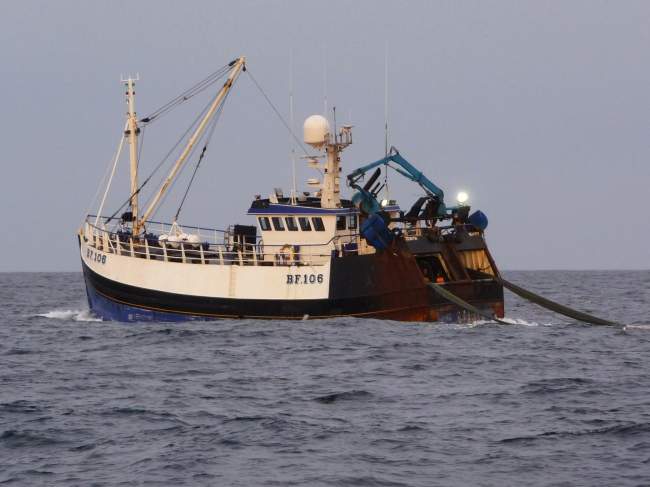
Top picture. ( Me at the seine net posing. Open decks, fifty foot boat.)

Bottom picture. (The Zenith trawling all enclosed decks, bigger boat.)


Enhanced by Zemanta